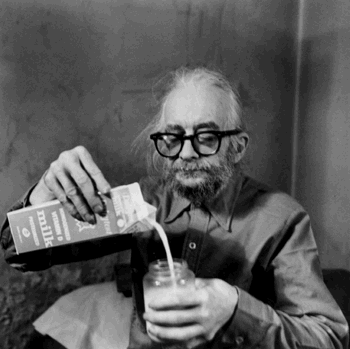
"In My Craft or Sullen Art" - Dylan Thomas
"In my craft or sullen art
Exercised in the still night
When only the moon rages
And the lovers lie abed
With all their griefs in their arms,
I labour by singing light
Not for ambition or bread
Or the strut and trade of charms
On the ivory stages
But for the common wages
Of their most secret heart.
Not for the proud man apart
From the raging moon I write
On these spindrift pages
Nor for the towering dead
With their nightingales and psalms
But for the lovers, their arms
Round the griefs of the ages,
Who pay no praise or wages
Nor heed my craft or art."
The method and meaning of any work are directly correlative. One does not occur without the other, and the comprehension of one will obviously illuminate the other. In order to understand the techniques an author employs, you first must read the work, a difficult and daunting task, I know. However, I think the best way to discern both the meaning and the method behind a work of literature, or otherwise, is to ask unceasing questions and make unrelenting observations. Many times the same questions that clarify the symbolism and themes of a piece will also help to elucidate the means by which the author created the work. Inquiries such as “why?” and “how?” can always help the audience to apprehend a piece more fully. This level of engagement with a text will vastly improve not only your awareness and knowledge of the piece, but also your connection to it, which will make the experience more intimate, as well as more enjoyable. Once personally invested, it will not be hard to want to interact with the text. Outside research can also enlighten certain aspects of a composition. Knowledge of the author or the era of the work will ultimately enhance the reader's understanding. As the audience begins to realize why the author wrote what (s)he did in the manner that (s)he did, a richer meaning behind the text will subsequently follow.
Sunday, January 29, 2012

The All American
"Homage to Phillip K. Dick" - Norman Dubie
"The illegal ditch riders of the previous night
Will deliver ice today.
The barbers up in the trees are Chinese.
They climb with bright cleats, bearing machetes—
It’s a season
Of low self-esteem for date palms on the street.
My visitor was at the door yesterday.
In a blue sere of a sucker suit.
An I Like Ike button
On the lapel. Holding a cup of sawdust.
He breathed through his eyes, crusted
With pollen.
I was not confused. It was God
Come to straighten my thoughts.
Whole celestial vacuums
In the trunk of his pink Studebaker.
We would smoke and cough.
I sat very still, almost at peace with myself.
He had shot a deer in the mountains. He thought
Last year’s winterkill was worse than usual.
I told him I didn’t know about guns.
Something forming on his forehead—a gloriole
Of splattered sun over snow.
We drank our lemonade in silence.
He asked if he could go. He joked
About his wife’s tuna casserole. As a gift
I signed for him my last paperback.
He left the book of matches. I’ll not enroll
In the correspondence course it offers
For commercial artists. What a relief
That the barbers in the trees are Chinese.
Green fronds are dropping in twos and threes
Around the bungalow, lessons
In the etiquette of diseased parrots. Bill Cody
Said it first, “If there is no God, then I am
His prophet.” Stop it. Please stop it."
Amidst the extensive research and discussion, the only thing I found out for sure about Philip K. Dick was that a myriad of people were sure quick to label the man as insane. For me, however, Philip K. Dick does not conjure up an image of illicit drug use and vivid hallucination, but rather represents the quintessential American. I see a man who suffered immensely in his lifetime, a man who endured great hardship, just like his country. Philip K. Dick witnessed the pain of three major wars, felt the commingling of fear and fascination as the atom bomb fell, and sensed the urgency of civil rights. Dick's life is synonymous to American life, and not just through the events that all Americans share through a strained and collective memory, but through the more personal encounters that Philip K. Dick endured as well. Philip K. Dick's only sibling and twin sister died six weeks after their birth where both of their names were inscribed on the same tombstone; a morbid reminder of the fate that awaited the one who survived. At the age of five his parents had divorced; an event that would set an example for his future love life, as he would marry and divorce five wives throughout his lifetime. As a writer, Dick would be incredibly prolific, but only marginally successful. Philip K. Dick would be diagnosed both as a schizophrenic and as a sane man, depending on the psychiatrist. Eventually Philip K. Dick would die at the young age of 53, not from a stroke, as many believe, but rather the arbitrary decision to turn off his life support system after a series of strokes. All of these events that occurred in his life helped to characterize him as a person, but not necessarily an atypical person. American society and history is wrought with mental illness and social woes. Dick's parents certainly were not the first to divorce each other. Philip's sister Jane, was not the first of a pair of twins to die, while the other survived. No one event in Philip's life was unusual or uncharacteristic of American life. In fact, one of the first purely American religious sects, Mormonism, came about as a result of hallucinations that were, in some respect, similar to those Philip K. Dick experienced. Ultimately, America was founded on the strange and the weird, the Kafkaesque and the obscene. From the Puritans to the Boston Tea Party to The Three-Fifths Compromise to the Civil War, Philip K. Dick is certainly no more unusual than the United States of America, or the rest of the world for that matter. Classic Americana consists of the moon landing, and the Twilight Zone, Coney Island, and the 49ers. So why are people so quick to judge and undermine the genius of this man? Like other American attributes, Philip K. Dick also showed a great talent for imagination and ingenuity. In many ways, Philip K. Dick was a prophet and a doctor of the modern world. He envisioned where society was headed, and identified contemporary problems that would need to be addressed. Through his writing he confronted the issues that faced America and the ideologies of the modern world. He asked confounding questions, and sometimes the illusive answers would wear his mind to the boundaries of sanity. Perhaps, people cannot come to terms with his inescapable inquiries or his unparalleled intellect, perhaps, his familiar lifestyle seems disquieting to those who seek the semblance of normalcy, or maybe they forget what it means to be American; which is a little surreal, a little odd, a little dysfunctional, and certainly imaginative.
"The illegal ditch riders of the previous night
Will deliver ice today.
The barbers up in the trees are Chinese.
They climb with bright cleats, bearing machetes—
It’s a season
Of low self-esteem for date palms on the street.
My visitor was at the door yesterday.
In a blue sere of a sucker suit.
An I Like Ike button
On the lapel. Holding a cup of sawdust.
He breathed through his eyes, crusted
With pollen.
I was not confused. It was God
Come to straighten my thoughts.
Whole celestial vacuums
In the trunk of his pink Studebaker.
We would smoke and cough.
I sat very still, almost at peace with myself.
He had shot a deer in the mountains. He thought
Last year’s winterkill was worse than usual.
I told him I didn’t know about guns.
Something forming on his forehead—a gloriole
Of splattered sun over snow.
We drank our lemonade in silence.
He asked if he could go. He joked
About his wife’s tuna casserole. As a gift
I signed for him my last paperback.
He left the book of matches. I’ll not enroll
In the correspondence course it offers
For commercial artists. What a relief
That the barbers in the trees are Chinese.
Green fronds are dropping in twos and threes
Around the bungalow, lessons
In the etiquette of diseased parrots. Bill Cody
Said it first, “If there is no God, then I am
His prophet.” Stop it. Please stop it."
Amidst the extensive research and discussion, the only thing I found out for sure about Philip K. Dick was that a myriad of people were sure quick to label the man as insane. For me, however, Philip K. Dick does not conjure up an image of illicit drug use and vivid hallucination, but rather represents the quintessential American. I see a man who suffered immensely in his lifetime, a man who endured great hardship, just like his country. Philip K. Dick witnessed the pain of three major wars, felt the commingling of fear and fascination as the atom bomb fell, and sensed the urgency of civil rights. Dick's life is synonymous to American life, and not just through the events that all Americans share through a strained and collective memory, but through the more personal encounters that Philip K. Dick endured as well. Philip K. Dick's only sibling and twin sister died six weeks after their birth where both of their names were inscribed on the same tombstone; a morbid reminder of the fate that awaited the one who survived. At the age of five his parents had divorced; an event that would set an example for his future love life, as he would marry and divorce five wives throughout his lifetime. As a writer, Dick would be incredibly prolific, but only marginally successful. Philip K. Dick would be diagnosed both as a schizophrenic and as a sane man, depending on the psychiatrist. Eventually Philip K. Dick would die at the young age of 53, not from a stroke, as many believe, but rather the arbitrary decision to turn off his life support system after a series of strokes. All of these events that occurred in his life helped to characterize him as a person, but not necessarily an atypical person. American society and history is wrought with mental illness and social woes. Dick's parents certainly were not the first to divorce each other. Philip's sister Jane, was not the first of a pair of twins to die, while the other survived. No one event in Philip's life was unusual or uncharacteristic of American life. In fact, one of the first purely American religious sects, Mormonism, came about as a result of hallucinations that were, in some respect, similar to those Philip K. Dick experienced. Ultimately, America was founded on the strange and the weird, the Kafkaesque and the obscene. From the Puritans to the Boston Tea Party to The Three-Fifths Compromise to the Civil War, Philip K. Dick is certainly no more unusual than the United States of America, or the rest of the world for that matter. Classic Americana consists of the moon landing, and the Twilight Zone, Coney Island, and the 49ers. So why are people so quick to judge and undermine the genius of this man? Like other American attributes, Philip K. Dick also showed a great talent for imagination and ingenuity. In many ways, Philip K. Dick was a prophet and a doctor of the modern world. He envisioned where society was headed, and identified contemporary problems that would need to be addressed. Through his writing he confronted the issues that faced America and the ideologies of the modern world. He asked confounding questions, and sometimes the illusive answers would wear his mind to the boundaries of sanity. Perhaps, people cannot come to terms with his inescapable inquiries or his unparalleled intellect, perhaps, his familiar lifestyle seems disquieting to those who seek the semblance of normalcy, or maybe they forget what it means to be American; which is a little surreal, a little odd, a little dysfunctional, and certainly imaginative.
Systematic Sampling
Very like a Whale by Brook Emery : The Poetry Foundation
Many of the dualistic tensions present in Dick's work are present here. This brings to light how very human these tensions are. Not only does Philip K. Dick struggle with constant, unending debates on the fate and nature of humanity, but so too does the rest of the world. Brook Emery is but one more example on the infinite list of humans who were dissatisfied and disconcerted by their own discoveries, observations, and inquiries. Emery brilliantly plays off the ideas of the centuries. He merges all the conflicting and disjointed ideologies of the past two centuries into a balanced portrayal of existence. The speaker of the poem encapsulates the human experience. The verses are wrought with the doubt and uncertainty of perception. Words like “seem,” “ambiguously,” “misconceive,” “unlikelihood,” “belief,” “imagined,” and “illusions,” set this tone of obscurity and confusion. Reality becomes fluid like the speaker's perception, within the context of the poem. This contrasts starkly with the theories and themes of Darwin and Dawkins, as Emery incorporates the resoluteness of science into the mix of human emotionality. The “peptides/ spelling out the phrase/ very like a whale” allude to a complex theory and practice invented and implemented by Richard Dawkins in order to prove and illuminate the nature of evolution in biological mechanisms, also known as Dawkin's weasel. The fact that Richard Dawkins chose to use Shakespeare in his experiments is mirrored throughout Emery's poem. The “clouds,” “camels,” “weasels,” and “whale[s],” of Hamlet's sky are all present within the text, and enrich its meaning. The idea that Hamlet was a character who could be both sane and insane within the context of the plot, and the fact that Richard Dawkins chose to use Hamlet to prove a wildly complex series of patterns, adds to this tone of surrealism and delusion. Emery uses these scientific discoveries to play off the notion that his words, the events that surround him, and his life have been naturally selected in a reality that is both wondrously illusive and positively concrete at the same time.
Sunday, January 22, 2012
Oh, the Semblance of Sanity
Dictionary.com defines “reality” as “the state or quality of being real.” The site then goes on to define “real” as “something that actually exists.” In truth, there aren't many things on this earth that are objectively, positively, materialistically, singularly, real or in a state of verifiable existence. Ultimately, what people generally perceive as reality has been, to some extent, demolished. A state of existence, any state of existence, remains purely subjective and relative. One person's reality can completely differ from another person's reality. The reality of a young Somalian boy does not in any way resemble that of a middle-aged white man from Boston. So we must accept that reality takes many forms at the same time, or that reality does not exist in the previously established context. Einstein proved, or appeared to prove, all this through his research and discovery of relativity. Soon things that were always considered materialistic and verifiable were dismissed as toys of perception, such as space and time. This now applies to the entirety of the universe. By disproving, or putting into question, this one aspect of so-called reality, we must now learn to deny or question anything that was implicitly acknowledged as reality. If existence is based on the principle of experience and all that can be measured by the senses, then reality cannot exist. How do we know we are experiencing what we are experiencing? Descartes' age-old aphorism “I think, therefore I am” holds little to no validity. According to the principles of science, observation, and rational thinking, descended from the Enlightenment, it should be “I think, therefore I think.” Despite it's Yogi Berra-like appearance, I still believe this sentiment holds value. The only proof in thinking is that you thought you had a thought at one point in time that may or may not have existed in reality. Measuring the present enters the realm of the absurd and the impossible. All we can do is attempt to measure the past, which is a figment of perception, and lacks verification. This is why humans have dedicated their lives to history and have documented their lives with the greatest care, because of an existential need to prove that they exist and have existed in reality. However, whatever anyone has documented or written or done has been in the past, which is not in the realm of reality because it is not existing at that moment in time. As soon as a thought or feeling or reaction enters your brain the experience has already passed. Another outlook to this paradox of the human condition is expressed by Buddha, “All that we are is the result of what we have thought. The mind is everything. What we think, we become.” While similar to Descartes' inference, I find Buddha's quote much more realistic in terms of the relationship he cites between the nature of existence, reality, and perception. Buddha places emphasis on the past tense; “[what] we are is... what we have thought.” The present condition and perception of all things is a result of what we have already thought, and what has been placed in the past. Since the past does not exist as something that can be experienced or measured in terms of the present, and the present is dependent on the past, there is neither past nor present. Just as Herskovits wrote regarding cultural relativism, one person may swear on his life that he was possessed by God, whereas another person would attribute the experience to hallucinatory pathology. Both perceptions are mute because both the experience and the diagnosis occurred in the past, and are therefore beyond the field of objectivity, but rather subjectivity. As I said before reality is dependent on the realm of measurable experiences and data, which are all fluid, intangible, and subject to manipulation through the means of personal perception. All of humanity is an abstraction, created on the assumption that what I may or may not have felt or experienced a few milliseconds ago actually occurred. This is an absurd and naïve assumption that simply cannot be proved, because as soon as you measure the synapses in the brain firing, which alludes to a possible reaction to something in the environment, the data has elapsed into the intangible former world of experience. The events that comprise our daily lives, the assumptions, the complacency is a ruse to make existence conceivable to the human mind, and is brought about by an inherent need for placement, meaning, and emotional security in a confusing and complex state. Furthermore, I completely realize the insanity and illogic present in all of these statements, because they were all conceived in the past and all constructed on past assumptions and evidence. In many ways, however, this just reaffirms my argument on the absurdity of trying to define reality, because nothing actually exists in a measurable, present form. Perhaps this is just my way of being contrarian for the sheer fun of it. However, whether verifiable or not, I still maintain that consciousness, experience, existence and reality could be illusory. So maybe it would be more appropriate to consider the second definition of “reality” that www.dictionary.com lists after all this confusion; “resemblance to what is real.”
Oral Traditions and The Colloquial Man
Oral communication and presentation constitute an immensely large portion of human existence, as well as academic endeavor. However, I feel scholars, and people in general, spend little time analyzing the way humans speak, or appreciating the art of storytelling, which, after all, catalyzed the formation and practice of the written word. Harry Smith, similar to Professor Higgins, could tell what county of the United States a man or woman originated after hearing them sing but a few bars of music. The oral tradition is so vital to our way of life, yet so depreciated. The progression and proliferation of technology has helped to alienate people from actually speaking on a day to day basis. So, I would like to spend some time honoring a person whom I feel embodies this slowly dying art form: Louis CK. In my opinion, Louis CK represents the perfect communion of the spoken and written language. I'm sure many would disagree with this statement, considering the high volume of profanity Louis CK uses in his routines, however, he is one of the few comedians who really considers the role of linguistics in everyday life, and the impact our lack of verbal skills has on the quality of society as a whole.
Louis CK even expands on the definitions and placement of specific diction within our culture. By writing out vulgar language and expanding upon the connotations of certain words, he attempts to understand and define these words with rationality, as opposed to placing common vocabulary among the taboo. In addition, Louis frequently says these words during his performances and in public, thus confronting the idea that a word in and of itself can be abusive, and removing these words from a context of fear and obscenity. I believe Louis CK would be a strong advocate of Cervantes' words, “The pen is the tongue of the mind." The idea that we all must own up to the words we use, hone our narrative skills, and portray an image with the honesty of a newly conceived thought, would certainly resonate with his bizarre sense of integrity.
Considering Louis has been in stand-up since he was nineteen, avid listeners can see his progression as an artist. More importantly his body of work materializes Joan Didion's thoughts on writing; she once wrote,“I write entirely to find out what I’m thinking, what I’m looking at, what I see and what it means. What I want and what I fear.” Louis hasn't always possessed this sense of aestheticism and sincerity. As a younger, less enlightened man, he felt that he could get by with a hollow Vaudeville-style act. As the years went by, he got married and had children, faced economic difficulties, and the same domestic troubles that nearly every family faces. He could no longer relate the product he was selling, the product being himself. He felt that the man on stage did not reflect the man in the mirror. So he changed his style and content to match how he felt. This emotional element makes his work viable. By using a frame of reference, recognizable to every dysfunctional family on the face of the earth, he was not only able to create a satisfactory profession on a personal level, but connect with the audience in a profoundly cathartic way. If the laughing in the background were to be cut from the audio of his work, and another man were to read his material dry, the effect would be tragic. Fortunately, Louis doesn't intend to make people cry or feel sympathetic toward him, but rather, allows the audience to relate to and laugh with him over the traumatic experiences in their own life. The audience doesn't simply laugh at a bunch of inane babble, but rather can identify with the experiences and observations Louis has on a daily basis. Brutally honest, brave, unashamed, candid, and at the same time therapeutic, Louis provides a service unmatched in the literary and performing world.
Unafraid and unhindered by the prospect of judgment and persecution, Louis uses comedy and the art of oral communication to invite opportunities for analysis and objective, critical thinking. Whether it's an existential examination of modern society, an exposé on the perversity of mankind, or just a wildly embarrassing confession, Louis, in some cases, uses the stage as a soapbox or pulpit. This enhances the thematic quality of his work above mere entertainment. Whether deliberately didactic, Louis' work always manages to inspire empathy, tolerance, inquiry, and greater comprehension of this complex world, along with a few liberating laughs. Louis CK, quite frankly, epitomizes the words of T.S. Eliot “Only those who risk going too far can possibly find out how far one can go.”
Louis CK even expands on the definitions and placement of specific diction within our culture. By writing out vulgar language and expanding upon the connotations of certain words, he attempts to understand and define these words with rationality, as opposed to placing common vocabulary among the taboo. In addition, Louis frequently says these words during his performances and in public, thus confronting the idea that a word in and of itself can be abusive, and removing these words from a context of fear and obscenity. I believe Louis CK would be a strong advocate of Cervantes' words, “The pen is the tongue of the mind." The idea that we all must own up to the words we use, hone our narrative skills, and portray an image with the honesty of a newly conceived thought, would certainly resonate with his bizarre sense of integrity.
Considering Louis has been in stand-up since he was nineteen, avid listeners can see his progression as an artist. More importantly his body of work materializes Joan Didion's thoughts on writing; she once wrote,“I write entirely to find out what I’m thinking, what I’m looking at, what I see and what it means. What I want and what I fear.” Louis hasn't always possessed this sense of aestheticism and sincerity. As a younger, less enlightened man, he felt that he could get by with a hollow Vaudeville-style act. As the years went by, he got married and had children, faced economic difficulties, and the same domestic troubles that nearly every family faces. He could no longer relate the product he was selling, the product being himself. He felt that the man on stage did not reflect the man in the mirror. So he changed his style and content to match how he felt. This emotional element makes his work viable. By using a frame of reference, recognizable to every dysfunctional family on the face of the earth, he was not only able to create a satisfactory profession on a personal level, but connect with the audience in a profoundly cathartic way. If the laughing in the background were to be cut from the audio of his work, and another man were to read his material dry, the effect would be tragic. Fortunately, Louis doesn't intend to make people cry or feel sympathetic toward him, but rather, allows the audience to relate to and laugh with him over the traumatic experiences in their own life. The audience doesn't simply laugh at a bunch of inane babble, but rather can identify with the experiences and observations Louis has on a daily basis. Brutally honest, brave, unashamed, candid, and at the same time therapeutic, Louis provides a service unmatched in the literary and performing world.
versus
Unafraid and unhindered by the prospect of judgment and persecution, Louis uses comedy and the art of oral communication to invite opportunities for analysis and objective, critical thinking. Whether it's an existential examination of modern society, an exposé on the perversity of mankind, or just a wildly embarrassing confession, Louis, in some cases, uses the stage as a soapbox or pulpit. This enhances the thematic quality of his work above mere entertainment. Whether deliberately didactic, Louis' work always manages to inspire empathy, tolerance, inquiry, and greater comprehension of this complex world, along with a few liberating laughs. Louis CK, quite frankly, epitomizes the words of T.S. Eliot “Only those who risk going too far can possibly find out how far one can go.”
Friday, January 20, 2012
Mr. Renard Sends His Warm Regards
Everything. Simply everything. Everything comes to mind when I read Philip's work. And I feel like I can call him Philip too. His writing makes him so vulnerable and transparent, so familiar and, yet, so fallible, he makes intimate friends of us all. We know his follies, his lack of self-esteem, his immense intelligence, his heartbreaking hardships. When an author can make me break into tears on the twenty-first page of a two hundred and forty-four page novel, I know not only that this man has skill as a writer, but that the emotions of this novel come from a genuine and sincere place, Philip K. Dick to be exact. More than the brutal honesty and inquiry that makes any novel successful, he managed to encapsulate the entirety of existence, and even non-existence, into only a couple hundred pages. What rare and afflicting gift possessed Philip to allow him to complete such a task? The same thought flows through my head when I read Ulysses or Waiting for Godot? And I believe that, one day, Philip K. Dick will be held in the same regard as Joyce and Beckett. In Do Androids Dream of Electric Sheep?, I, too, see The Odyssey. The long, exhaustive journey played out in full by Rick Deckard. The Sirens leading the protagonist astray. The imagery of forgotten quests and conquests, a horse and a fake sheep. The horse reminiscent of the Trojan Horse and the sheep evocative of that sheep's hide Odysseus wore to escape from certain death. Rick Deckard easily embodies Odysseus, as he is an imperfect character. He fought a battle for survival in his past, but nothing prepared him for the war going home. All of his values and ideals were challenged, he accomplished some dubious tasks, and he is certainly imperfect. The audience is unsure whether he likes Rick Deckard by the novel's end, the same with Odysseus. He cheated on his waiting wife, and his age is apparent by the end of the day. Perhaps, even, infertile due to the groin injury he obtained, which is certainly a symbol of age. By the last chapters of Do Androids Dream of Electric Sheep?, Iran exemplifies the ever patient and maternal Penelope. While these parallels make a great case for certain elements in the story, I see much, much more. These symbols overlap one another to create a grand and all-encompassing vision of simply everything. Wilbur Mercer, who, in the context of The Odyssey, could be related to Calypso; a guiding force that leads Rick Deckard home, could also be interpreted as any number of historical figures, namely Jesus Christ and Buddha. Mercer most definitely shows signs of being a Christ figure. The idea of a man who can perform miracles at a very young age and then suffers persecution, also seems like Jesus. The imagery of making the grueling hike up a hillside to rejuvenate mankind and all life, while others torture him, absolutely sounds like Christ to me. The idea of rebirth and resurrection should always remind audiences of this famous man. The long period in which Mercer stays at the bottom of the hill, tormented by demonic visions of death, should remind all those who are even vaguely familiar with the New Testament of the Garden of Gethsemane. Also donkeys, sheep, and crows which appear in the novel several times are representative of three significant phases in Jesus' life. But these features don't only apply to Jesus Christ. The fact that Mercer was an orphan (see page 23, a small, but true detail) resembles the life history of Muhammad, another vitally important religious leader. The fact that Muhammad would walk the face of Mount Hira for religious meditation, also resembles Mercer's journey. It is said, according to Islamic scripture that Muhammad, after being visited by an angel, thought about committing suicide and thought that no one would believe him. This is similar to how Rick Deckard feels after experiencing life in Mercer's shoes. The affinity for animals, belief in rebirth, empathy, and unity of Mercerism mirrors many of the beliefs of Buddhists and Hindus. Hindus hold animals in high esteem, are often vegetarian, and believe in reincarnation. The same goes for Buddhists. Buddha emphasized, however, the importance of empathy, unity with fellow living things, and suffering, which are all apparent throughout the course of the novel. The Four Noble Truths can be found throughout Rick Deckard and John Isidore's ventures as both suffer tremendously in their own ways, and learn empathy and unity through common ideas of empathy and rebirth. The idea of a false reality is also present within Buddhism. The most emotional moment of Rick Deckard's venture comes when he finds a frog, a species supposed to be extinct. After learning the frog is simply an android, we can still derive great meaning from it's existence in the plot line. One: Rick Deckard suffers a supreme emotional loss because of this discovery, and, two: reality is an illusion, something that Buddha highly endorsed. Buddha felt that the only real and permanent form of existence came with Nirvana and the idea of evolved emotional capacities that could perfectly empathize and love others in the face of this illusion of reality and demoralizing desires and selfishness. However, one fact about Indian life Buddha did not advocate was the Pariah State, in which classes were strictly divided into those who were worthy of living and those who were not. This dichotomy is present in the form of “humans” versus “androids” in Do Androids Dream of Electric Sheep? As Rick Deckard ventures out of his comfort zone, and embarks on this mission, his ideas of the value of life and what constitutes life vastly differ when he returns home the next day. This transformation is similar to, yes, Odysseus, but also Gautama Buddha's journey from luxury and ignorance to enlightenment. By the end of the day, Rick isn't entirely sure that he has done the right thing, and this is important for the reader to understand, especially that he feels guilt on behalf of and empathy for these androids, the supposed pariahs of Earth. Philip K. Dick also looks to all these religions, and many more, when picking out the specific animals present in the story, for the most saturated amount of meaning and symbolism in the context, of which I could go on forever. Ultimately each religious allusion points to the idea of the martyr, love, and a strong sense of spirituality, in this sense, Earth's society is divided in yet another way, those who believe in religion and those who identify with science and rationality. This demonstrates a tumultuous period in human history, a period that is still going on today, the ideological war between atheists and religious thinkers. Philip is clearly adroit when he brings up this topic. He recognizes the fact that many of the people who claim to advocate love and empathy perpetrate the most violence, such as the case with Rick Deckard. However, Philip also recognizes the devastation many atheist caused in being so disrespectful with regard to human faith and hope for the future, such is the case with John Isidore versus the Batys and Pris Stratton. Philip accentuates the imperfection on both sides, which really is the basis for all humanity, a poignant theme to keep in mind.
In conclusion, I thought I would leave you with some words by Walt Whitman, which I found appropriate. It is a segment from "I Sing the Body Electric" from Leaves of Grass.
"A man’s Body at auction;
I help the auctioneer—the sloven does not half know his business.
Gentlemen, look on this wonder!
Whatever the bids of the bidders, they cannot be high enough for
it;
For it the globe lay preparing quintillions of years, without one
animal or plant;
For it the revolving cycles truly and steadily roll’d.
In this head the all-baffling brain;
In it and below it, the makings of heroes."
In conclusion, I thought I would leave you with some words by Walt Whitman, which I found appropriate. It is a segment from "I Sing the Body Electric" from Leaves of Grass.
"A man’s Body at auction;
I help the auctioneer—the sloven does not half know his business.
Gentlemen, look on this wonder!
Whatever the bids of the bidders, they cannot be high enough for
it;
For it the globe lay preparing quintillions of years, without one
animal or plant;
For it the revolving cycles truly and steadily roll’d.
In this head the all-baffling brain;
In it and below it, the makings of heroes."
Sunday, February 20, 2011
Something To Do With That Mark Clemens Man
“Girl” (1984) – Jamaica Kincaid
“this is how to sew on a button; this is how to make a buttonhole for the button you have just sewed on; this is how to hem a dress when you see the hem coming down and so to prevent yourself from looking like the slut I know you are so bent on becoming”
10:00 P.M. Sunday. Take out the anthology. Flip to a page. Read.
Taking the usual steps toward blog-post completion, of course the night of the due date, I found this charming tidbit in the “Fiction For Further Reading.” In and amongst the typical short stories that inhabit this section this caught my eye. Too lazy for a judgmental and extensive selection process I decided to go ahead and read the piece. I noticed right away that this could hardly fit into the same category as the other short stories, in fact the mere paragraph could hardly be considered fiction. To my senses it was a clever list; a list derived from reality and true life experience to be sure. The nature of the format makes the content seem so real, as if Kincaid has just copied the statements from real life, which made me ponder on the status of fiction in general. Isn't all fiction in reality non-fiction, just a series of experiences and memories translated to the page in different styles and variations? Indeed. In this instance the reality is specific to gender and geographic roles. A mother indicates to a young woman all that makes a proper lady. So of course the expository rant of demands and instructions includes sewing, cooking, setting the table, ironing, washing clothes, grocery shopping, proper conduct, and all the things that make a woman: everything that doesn't make a man. A man of course does not cook his own food, or wash his own clothes. A man does not have to be demure or monogamous. A woman, however, must. Or else. Or else what? She is a slut. This piece focuses on expectations, and ironically plays upon the reality of these expectations. While for us these stereotypical roles seem outdated, if not sexist and indeed archaic, they hold a vast amount of truth or else we, the audience, would not be able to recognize the irony, laugh at its mild humor, and relate to the very humanity of its theme. The wit and talent of the writing comes from the idea of combining multiple assumptions about various groups of people. The work contains such things as “okra,” “benna,” “dasheen,” “doukona,” etcetera. All of these things are characteristic of a Caribbean environment. The subject matter is associative of a relationship between mother and daughter. The mother is the stereotypical woman in her characteristic society. Anything other than the norm is normally considered atypical. All the aspects of this piece combine to play on the expectations of the reader. In fact the speaker is actually telling the audience what to expect through these strict demands and assumptions. The speaker assumes that her daughter wants to be a slut, because she acts differently; by “play[ing] marbles” and asking questions. When the daughter asks questions like, “what if the baker won't let me feel the bread?” the mother automatically concludes that her daughter has made the decision to become a slut. Why? Because she cannot take all this advice and “wisdom” on faith, and continues to inquire about the world; an unacceptable role for a woman, which is why the piece is titled “Girl.” The real lesson comes from the latter part of the story, where the mother briefly starts to tell of nontraditional skills, that she must have learned from being a “slut” or liberated and unconfined “girl” herself, with lines like “this is how to make a good medicine to throw away a child before it even becomes a child,” “this is how to bully a man,” or “this is how to spit up in the air if you feel like it.” The mother's severity dissipates and allows for the irony to continue, as honest expectations fade into truthful imperfection. On a similar note the idea of free spirited girl versus matronly woman reminds me of Harry Smith, to whom this blog is partially dedicated. An American folk song from his anthology is titled "Single Girl Married Girl," the song parallels the idea of typical gender roles in society, to which the lyrics are as follows:
"Single girl, oh single girl
She's gone anywhere she please
Oh, gone anywhere she please
Married girl, oh married girl
Got a baby on her knees
Oh, got a baby on her knees
Single girl, oh single girl
She's going dressed up so fine
Oh going dressed up so fine
Married girl, oh, married girl
She wears any kind
Oh, she wears any kind
Single girl, oh single girl
She goes to the store and buys
Oh goes to the store and buys
Married girl, oh, married girl
She rocks the cradle and cries
Oh, rocks the cradle and cries
Single girl, oh single girl
She lays in bed 'til one
Oh lays in bed 'til one
Married girl, oh, married girl
She's up before the sun
Oh, up before the sun
Single girl, oh single girl
She's looking for a man
Oh looking for a man
Married girl, oh, married girl
She's got her wedding band
Oh, got her wedding band"
The song mirrors the irony of Kincaid's work, by presenting the irony of a "girl's" situation. A girl wants maternal responsibilities, but also resents the loss of independence once such is found. The song also lends insight into why the mother so adamantly stresses not becoming a "slut," and gives her daughter instructions on how to perform an abortion and become a respected woman, as she does not want her to lead the same life. Ultimately, the title gives the piece a sense of future and uncertainty, the prospect of growth and maturity (or lack thereof), as a mother attempts to dispense some knowledge to her youthful progeny.
I fully endorse this form of creativity, it is not quite stream of consciousness, it should be categorized as selective hearing or memory, as all the things that we can or choose to remember, that we record from the one-sided conversations. Something that looks too real not to be. Too short to have meaning, yet too repetitive not to. In short, I think I like it. I applaud the publisher's choice to include the piece, and think even more highly of this anthology in general. I'm sure Mr. McCarthy would agree that this creative composition consists of the “Madman” concept of the construction process, and in many ways is successful in this organic form, without further development or plot. If I were to experiment with this writing technique I would once again venture to say that such an invention would not in any way be detrimental to my writing, especially considering how deficient my skills are currently, how could it hurt?
“this is how to sew on a button; this is how to make a buttonhole for the button you have just sewed on; this is how to hem a dress when you see the hem coming down and so to prevent yourself from looking like the slut I know you are so bent on becoming”
10:00 P.M. Sunday. Take out the anthology. Flip to a page. Read.
Taking the usual steps toward blog-post completion, of course the night of the due date, I found this charming tidbit in the “Fiction For Further Reading.” In and amongst the typical short stories that inhabit this section this caught my eye. Too lazy for a judgmental and extensive selection process I decided to go ahead and read the piece. I noticed right away that this could hardly fit into the same category as the other short stories, in fact the mere paragraph could hardly be considered fiction. To my senses it was a clever list; a list derived from reality and true life experience to be sure. The nature of the format makes the content seem so real, as if Kincaid has just copied the statements from real life, which made me ponder on the status of fiction in general. Isn't all fiction in reality non-fiction, just a series of experiences and memories translated to the page in different styles and variations? Indeed. In this instance the reality is specific to gender and geographic roles. A mother indicates to a young woman all that makes a proper lady. So of course the expository rant of demands and instructions includes sewing, cooking, setting the table, ironing, washing clothes, grocery shopping, proper conduct, and all the things that make a woman: everything that doesn't make a man. A man of course does not cook his own food, or wash his own clothes. A man does not have to be demure or monogamous. A woman, however, must. Or else. Or else what? She is a slut. This piece focuses on expectations, and ironically plays upon the reality of these expectations. While for us these stereotypical roles seem outdated, if not sexist and indeed archaic, they hold a vast amount of truth or else we, the audience, would not be able to recognize the irony, laugh at its mild humor, and relate to the very humanity of its theme. The wit and talent of the writing comes from the idea of combining multiple assumptions about various groups of people. The work contains such things as “okra,” “benna,” “dasheen,” “doukona,” etcetera. All of these things are characteristic of a Caribbean environment. The subject matter is associative of a relationship between mother and daughter. The mother is the stereotypical woman in her characteristic society. Anything other than the norm is normally considered atypical. All the aspects of this piece combine to play on the expectations of the reader. In fact the speaker is actually telling the audience what to expect through these strict demands and assumptions. The speaker assumes that her daughter wants to be a slut, because she acts differently; by “play[ing] marbles” and asking questions. When the daughter asks questions like, “what if the baker won't let me feel the bread?” the mother automatically concludes that her daughter has made the decision to become a slut. Why? Because she cannot take all this advice and “wisdom” on faith, and continues to inquire about the world; an unacceptable role for a woman, which is why the piece is titled “Girl.” The real lesson comes from the latter part of the story, where the mother briefly starts to tell of nontraditional skills, that she must have learned from being a “slut” or liberated and unconfined “girl” herself, with lines like “this is how to make a good medicine to throw away a child before it even becomes a child,” “this is how to bully a man,” or “this is how to spit up in the air if you feel like it.” The mother's severity dissipates and allows for the irony to continue, as honest expectations fade into truthful imperfection. On a similar note the idea of free spirited girl versus matronly woman reminds me of Harry Smith, to whom this blog is partially dedicated. An American folk song from his anthology is titled "Single Girl Married Girl," the song parallels the idea of typical gender roles in society, to which the lyrics are as follows:
"Single girl, oh single girl
She's gone anywhere she please
Oh, gone anywhere she please
Married girl, oh married girl
Got a baby on her knees
Oh, got a baby on her knees
Single girl, oh single girl
She's going dressed up so fine
Oh going dressed up so fine
Married girl, oh, married girl
She wears any kind
Oh, she wears any kind
Single girl, oh single girl
She goes to the store and buys
Oh goes to the store and buys
Married girl, oh, married girl
She rocks the cradle and cries
Oh, rocks the cradle and cries
Single girl, oh single girl
She lays in bed 'til one
Oh lays in bed 'til one
Married girl, oh, married girl
She's up before the sun
Oh, up before the sun
Single girl, oh single girl
She's looking for a man
Oh looking for a man
Married girl, oh, married girl
She's got her wedding band
Oh, got her wedding band"
The song mirrors the irony of Kincaid's work, by presenting the irony of a "girl's" situation. A girl wants maternal responsibilities, but also resents the loss of independence once such is found. The song also lends insight into why the mother so adamantly stresses not becoming a "slut," and gives her daughter instructions on how to perform an abortion and become a respected woman, as she does not want her to lead the same life. Ultimately, the title gives the piece a sense of future and uncertainty, the prospect of growth and maturity (or lack thereof), as a mother attempts to dispense some knowledge to her youthful progeny.
I fully endorse this form of creativity, it is not quite stream of consciousness, it should be categorized as selective hearing or memory, as all the things that we can or choose to remember, that we record from the one-sided conversations. Something that looks too real not to be. Too short to have meaning, yet too repetitive not to. In short, I think I like it. I applaud the publisher's choice to include the piece, and think even more highly of this anthology in general. I'm sure Mr. McCarthy would agree that this creative composition consists of the “Madman” concept of the construction process, and in many ways is successful in this organic form, without further development or plot. If I were to experiment with this writing technique I would once again venture to say that such an invention would not in any way be detrimental to my writing, especially considering how deficient my skills are currently, how could it hurt?
Sunday, February 13, 2011
Relative Romantic Associations
“you fit into me” (1971) – Margaret Atwood
“you fit into me
like a hook into an eye
a fish hook
an open eye”
As Ms. Smith and I were discussing both Romantic and romantic activities to do for Monday's Valentine's Day English class, we briefly talked on how the utilization of foreign or at least unexpected objects as metaphors for emotion and thought can indeed translate into both Romantic and romantic poetry. Atwood's poem perfectly exemplifies this idea. The concept of love is obviously nothing new, so interpreting it as something more profound than age-old adages of roses and classical nymphs transforms the definition of love and poetry in general. Not that cupid wasn't a creative innovation in his day, or the idea of relating natural beauty to emotional beauty, but allowing poetry to evolve is part of its perpetual cycle and everlasting renewal. Here the audience sees a hook and eye. A common, if not somewhat outdated object; completely utilitarian. Some associations to compliment a hook and an eye would perhaps be of another more simple era, and of course a doorway. Atwood relies on these common associations to make the poem successful in relaying her emotions to her intended audience, whomever that may be. She speaks of a love that perfectly fits, one person with another. But the irony comes with the realization that the hook and eye are not prevalent in her contemporary world. And so, the role of the primitive lock comes into play, almost as if barring the complications of a modern culture from her more simple and pure experience with love. The second stanza generates another association with the concept of a hook. With the specification of a “fish hook” other connections come to mind. Obviously fishing, but also the role that a fish hook partakes in the fishing process, also helps to create deeper meaning. Instantaneously, I think of a tantalizing lure that cruelly captures the ignorant aquatic creature. Combining that relation to romantic relationships, the reader contemplates a type of sorrowful seduction where the speaker becomes a casualty of love. However, the last line clarifies this ongoing and shifting metaphor: “an open eye.” This expresses a comprehension and omniscience about a supposed bait, and willingness of being caught. Ultimately both these correlations whether intended by Margaret Atwood or not, have helped to compose a nontraditional and highly thoughtful image of love.
“you fit into me
like a hook into an eye
a fish hook
an open eye”
As Ms. Smith and I were discussing both Romantic and romantic activities to do for Monday's Valentine's Day English class, we briefly talked on how the utilization of foreign or at least unexpected objects as metaphors for emotion and thought can indeed translate into both Romantic and romantic poetry. Atwood's poem perfectly exemplifies this idea. The concept of love is obviously nothing new, so interpreting it as something more profound than age-old adages of roses and classical nymphs transforms the definition of love and poetry in general. Not that cupid wasn't a creative innovation in his day, or the idea of relating natural beauty to emotional beauty, but allowing poetry to evolve is part of its perpetual cycle and everlasting renewal. Here the audience sees a hook and eye. A common, if not somewhat outdated object; completely utilitarian. Some associations to compliment a hook and an eye would perhaps be of another more simple era, and of course a doorway. Atwood relies on these common associations to make the poem successful in relaying her emotions to her intended audience, whomever that may be. She speaks of a love that perfectly fits, one person with another. But the irony comes with the realization that the hook and eye are not prevalent in her contemporary world. And so, the role of the primitive lock comes into play, almost as if barring the complications of a modern culture from her more simple and pure experience with love. The second stanza generates another association with the concept of a hook. With the specification of a “fish hook” other connections come to mind. Obviously fishing, but also the role that a fish hook partakes in the fishing process, also helps to create deeper meaning. Instantaneously, I think of a tantalizing lure that cruelly captures the ignorant aquatic creature. Combining that relation to romantic relationships, the reader contemplates a type of sorrowful seduction where the speaker becomes a casualty of love. However, the last line clarifies this ongoing and shifting metaphor: “an open eye.” This expresses a comprehension and omniscience about a supposed bait, and willingness of being caught. Ultimately both these correlations whether intended by Margaret Atwood or not, have helped to compose a nontraditional and highly thoughtful image of love.
Sunday, February 6, 2011
Theoretics
“The Disappearance” (1995) – Chitra Banerjee Divakaruni
“Years later, when he was an old man living in a home for seniors (his second wife dead, his daughters moved away to distant towns, his son not on speaking terms with him), he would continue to be dazzled by that brief unguarded joy on her face, would say to himself, again, how much she must have hated me to choose to give that up.
But he had no inkling of any of this yet. So he switched off the trash compactor with a satisfied click, the sense of a job well done and, after taking a shower (long and very hot, the way he liked it, the hard jets of water turning the skin of his chest a dull red), went to bed and fell immediately into a deep, dreamless sleep.”
Effortlessly and nonchalantly Divakaruni seems to encompass the entirety of familial folly in her work. After his wife secretly leaves him, how carelessly the misogynist thinks that he can discard her memory. Those are the moments that define our entire existence, the ones that we can never forget, the ones that ring hollowly through our minds until the very end. A quote from Venus seems to sum up this entire short story;
“'For most men a woman's body is the most beautiful thing they will ever see.'
'What's the most beautiful thing a girl sees? Do you know?'
'Her first child.'”
And through this story we see how each gender fights for each “beautiful” thing. With the husband, the audience sees how he marries a woman the same week that he meets her, endangers his marriage with sexual demands, estranges his son by marrying another woman, and practically destroys himself seeking this one thing. With the grandmother we see exactly the same, she pressures her son to marry so that she can attempt to recreate the joy of childbirth through a grandchild, then she happily takes the place of homemaker after her daughter-in-law leaves so that she can be nearer to her son and grandson, then she further meddles in her son's life by getting him to remarry and have more grandchildren. The audience witnesses how both parties attempt to pretend like nothing has happened, and demean the wife's influence and power, by selfishly yearning for their precious desires. This is what makes the wife heroic. She abandons the one thing in her life that makes her most happy; her son. As if to teach him an invaluable lesson, by disappearing she makes a statement to her son that such abusive tendencies on the part of his father are unjustifiable. With her escape, the son eventually breaks away himself from the dust strewn traditions of an uncivil past. The distasteful secrets of married life, childhood, and parenting all come out in this short story, along with the pangs of human life in general. As the husband bitterly finds out that his wife was not abducted, but rather ran away, his pride and anger lead to his ultimate downfall in classic hubris form. Alone and self-betrayed he must face a truth that he has so long hidden.
The author shrewdly leaves quotation punctuation out of her tragic tale. In this way the speaker is separate, yet connected to the thoughts, actions, and dialogue of each character. Using dialogue in such an unlikely way compresses the work, like the inescapable truth and pressure that the main character feels. The perspective also becomes unique, as third person omniscient combines with first person limited. More importantly the dialogue is not stressed in this format, as it generally is with most work. With the separation of dialogue by paragraphs for each character and the obvious quotation marks, the eye is drawn to this emphatic component. Without this structure, the feeling fades from the remarks and becomes almost apathetic or uncaring, thus leaving the audience unsympathetic to the husband's plight; an important aspect of the story. Morphing common practices to the needs of a story is absolutely vital, and should not be avoided. Utilizing imagination and atypical methodology should always be welcomed in the literature community, since these are factors of which it so highly depends upon.
Friday, January 14, 2011
Steel-cut Oats
“Grief” - Elizabeth Barrett Browning
“I tell you, hopeless grief is passionless;
That only men incredulous of despair,
Half-taught in anguish, through the midnight air
Beat upward to God's throne in loud access
Of shrieking and reproach. Full desertness,
In souls as countries, lieth silent-bare
Under the blanching, vertical eye-glare
Of the absolute Heavens. Deep-hearted man, express
Grief for thy Dead in silence like to death--
Most like a monumental statue set
In everlasting watch and moveless woe
Till itself crumble to the dust beneath.
Touch it; the marble eyelids are not wet:
If it could weep, it could arise and go.”
That only men incredulous of despair,
Half-taught in anguish, through the midnight air
Beat upward to God's throne in loud access
Of shrieking and reproach. Full desertness,
In souls as countries, lieth silent-bare
Under the blanching, vertical eye-glare
Of the absolute Heavens. Deep-hearted man, express
Grief for thy Dead in silence like to death--
Most like a monumental statue set
In everlasting watch and moveless woe
Till itself crumble to the dust beneath.
Touch it; the marble eyelids are not wet:
If it could weep, it could arise and go.”
Shock, eternal resignation, a paralyzing stillness. These are the things that Browning recognizes in her examination of grief. We are not those who discredit and disbelieve despair, we, who know it well, saturate ourselves in it, and drown without noise, without struggle. We do not long for normalcy, nor verdant emotion, we accept a tragic fate that leaves us broken, with the rationality of fatigue, of a listlessness that extends into unknown depths. It permeates, it slowly weathers away intricate nerve endings, it inhabits and hijacks our very bodies, until truth becomes vacant, and form barred. Until the movement of this suffocating mass becomes as physically impossible as a statue shedding marvelous tears. Do I know grief? Only as one knows smelling, not all possess the sense, but even those who do could never describe it accurately. Browning comes close, but she could never translate this poem to those who have never felt what she has experienced, just as I could never explain the smell of infiltrating smoke or creeping mold to someone who has never used their nose. Like a parasite it feeds on our mere existence, and we solemnly accept this relationship, as we dwindle into dehydrated fruit. Like a line, imaginary, endless, and impossible we remain in these purgatories, indeed until we “crumble.”
I could go on to talk about how Browning uses a seamless a-b-b-a-a-b-b-a-c-d-e-c-d-e rhyme scheme, using true, and slant rhymes to make the poem less artificial and intrusive, but I cannot. I believe that a mindless praise and analysis of such would be disrespectful and almost inappropriate. The work has affected me greatly, and that's all that really needs to be said. Browning has a gift for profound authenticity and connection, as someone who can relate to the work, and collapse in its verses, I can honestly say that such skill is welcome in composition.
Monday, January 10, 2011
The Insistent Plea Still Rings
“Do not go gentle into that good night” (1951) – Dylan Thomas
“Do not go gentle into that good night,
Old age should burn and rave at close of day;
Rage, rage against the dying of the light.
Though wise men at their end know dark is right,
Because their words had forked no lightning they
Do not go gentle into that good night.
Good men, the last wave by, crying how bright
Their frail deeds might have danced in agreen bay
Rage, rage against the dying of the light.
Wild men who caught and sang the sun in flight,
And learn, too late, they grieved it on its way,
Do not go gentle into that good night.
Grave men, near death, who see with blinding sight
Blind eyes could blaze like meteors and be gay,
Rage, rage against the dying of the light.
And you, my father, there on the sad height,
Curse, bless, me now with your fierce tears, I pray.
Do not go gentle into that good night.
Rage, rage against the dying of the light.”
Old age should burn and rave at close of day;
Rage, rage against the dying of the light.
Though wise men at their end know dark is right,
Because their words had forked no lightning they
Do not go gentle into that good night.
Good men, the last wave by, crying how bright
Their frail deeds might have danced in a
Rage, rage against the dying of the light.
Wild men who caught and sang the sun in flight,
And learn, too late, they grieved it on its way,
Do not go gentle into that good night.
Grave men, near death, who see with blinding sight
Blind eyes could blaze like meteors and be gay,
Rage, rage against the dying of the light.
And you, my father, there on the sad height,
Curse, bless, me now with your fierce tears, I pray.
Do not go gentle into that good night.
Rage, rage against the dying of the light.”
The word villanelle comes from the Latin word “villanella” meaning rustic. As perhaps the most well-known and celebrated of the villanelles, “Do not go gentle into that good night” indeed incorporates a rustic tone and sincerity. Written shortly after the death of his father, Dylan Thomas transformed his confusion, grief, and anger at the loss into a desperate plea. The repetition of lines, and rhymes (as is typical in a villanelle) help to create this tragic tone. Like the soft waves of tears the come in and out like the tide, Thomas indulges in the same feeling through his mournful composition. The honor, love, and respect that he held for his father is also evident in the numerous stanzas. Dylan Thomas also addresses the need for legacy in life. These “wise men,” “good men,” “wild men,” and “grave men” know well enough to fight to the end for life, when all seems meaningless and trivial. Thomas speaks to the brevity of life as well as even these most noble men, with lives full, cannot impact the world enough to leave a legacy. With this and the intolerable loss he had to face, Dylan Thomas begs each man to combat an empty life, but more importantly an arbitrary death, to not surrender to apathy and tradition, but to expire with passion, so that the light may never die.
The revival of formalism is imperative in current writing, deconstruction is often popular in contemporary composition, but this wondrous poem, identifies the advantages of formalism for certain topics and themes. The insistence of the stanzas does not subside, like those going “gentle into that good night,” but instead rages “against the dying of the light.” The villanelle impacts the audience firmly within this context, because of this very repetition, and formalism. The structure simply reaffirms Thomas’ theme, and without it would become ineffective. If Thomas was to, for instance, write a haiku, attempting to carry this theme, his structure would only display the exact opposite of what he was trying to get across. The number of words used in a haiku, or less verbose type of poem, would also betray the persistence of his message. Though it requires great skill, and time, a villanelle can be one of the strongest forms of poetry.
Sunday, January 9, 2011
Stone Knifes and Bearskins
“Some Good Things to Be Said for the Iron Age” (1970) - Gary Snyder
“A ringing tire iron
dropped on the pavement
Whang of a saw
brusht on limbs
the taste
of rust”
Snyder adequately expresses his prophesy of and excitement for the demise of the Iron Age in his brief yet cunning poem. The “ringing tire iron” symbolizes the effects of the iron age, as if echoing out throughout the centuries. However the phrase “dropped on the pavement” brings to mind the abandonment of this long lasting era in human development, as if this technology abruptly ended, as a point on a time line. The placement of this line to the right of the first would suggest the same thing, as if in the future the Iron Age will terminate. The severe onomatopoeias present in this succinct poem indicate Snyder's impression of the harsh and unnatural form of the Iron Age such as with the word “whang,” this impresses upon the reader the feeling of a alien like noise. In the next line the word “brusht” also displays a sharp severity, a facet of the Iron Age, but also implies a past tense, as if to reassure the audience that the Iron Age will indeed conclude. Finally “the taste of rust” gives the reader a sense of destruction and deterioration, as the infamous age comes to a close. The last four lines become shorter and shorter in length creating a poignant form, coming to a point, as if slowly eroding as Snyder clearly professes the Iron Age will. Obviously including the title in Snyder's overall theme, he simply reaches out to say that the best thing “to be said for the Iron Age” is its overall termination.
The profound use of shape literally become imagery within this poem. Visually shape is an extraordinary way of capturing an audience's attention. As Thomas Foster clearly states, “if it's square it's a sonnet,” while this is just one way of quickly identifying a form of poem, he is right to emphasis the importance of shape in poetry. Especially since the brevity makes the word usage more subjective, because there is less body to put them into context, Snyder relies heavily on shape to clarify the meaning of the short phrases he applies. Snyder exponentiates the meaning of the few words he does uses, by eliminating the worthless baggage that comes with formal writing. In rejecting the usual structure of composition, Snyder gives every word a purpose and objective. The title has a invaluable mission as well. This atypically long title (especially considering the length of the overall poem) draws attention to itself in order to direct the reader's mind to a specific topic before reading the rest of the poem. Snyder's effective use of a title helps to engage the reader in the proper way, so that the meaning is not lost to confusion. I think that both these literary components are imperative to shorter poems. If a person wants to be brief, hard-hitting, and clever with a few words, meaning must still be sustained. Without the proper guidelines, such as with the use of shape and title the average audience will be disoriented in trying to define its theme and symbolism.
Friday, January 7, 2011
Respite For The Violent
“First Fight. Then Fiddle” (1949) - Gwendolyn Brooks
“First fight. Then fiddle. Ply the slipping string
With feathery sorcery; muzzle the note
With hurting love; the music that they wrote
Bewitch, bewilder. Qualify to sing
Threadwise. Devise no salt, no hempen thing
For the dear instrument to bear. Devote
The bow to silks and honey. Be remote
A while from malice and from murdering.
But first to arms, to armor. Carry hate
In front of you and harmony behind.
Be deaf to music and to beauty blind.
Win war. Rise bloody, maybe not too late
For having first to civilize a space
Wherein to play your violin with grace.”
Brooks speaks to the towering contradictions of the proponents of war. Seeming “Renaissance” men who have not only a fine skill for violent tactics, but surprising the violin as well. In many ways this poem connects to the archetype of Mr. Kurtz within Heart of Darkness. Within this respected man lies various talents for painting, playing a musical instrument, writing, and perhaps above all the aptitude for speaking. The golden standard for Imperialist Europe, Kurtz then deteriorates into an unwholesome shadow that whispers foul tidings from the inner sanctums of a symbolic hell. This metamorphosis, or rather devolution, parallels that in Brooks' poem. Those with a sensitive attraction towards music and art, abandon their high ideals with a vicious blood lust. The civilized manners of class and society crumble against testosterone-fueled crusades. In a dissimilar perspective, Brooks could also be addressing the foolhardiness of young warmongers with an impatience to prove themselves to the world. As a result the consuming hate leaves only a murmuring mold of a man, who desperately attempts to forget his past naivety through a love of music. However perceived, Brooks injects an equal amount of passion in the descriptions of both pastimes, insuring that the reader understands the brutal irony of the poem's subject. In either case the poem still leaves a didactic and rather poignant theme.
Brooks combines both the structures of the traditional Shakespearean sonnet, and the Italian sonnet to create a fresh rhyme scheme that still neatly encases her work in an organized manner (at least more so than the free verse). “First Fight. Then Fiddle” incorporates the rhyming pattern "abbaabbacddcee." This rhyme scheme compares to that of the Italian, except for the last two verses which adhere to the Shakespearean standard. Brooks also utilizes iambic pentameter which is also typical in Shakespearean sonnets. This format maintains a sense of originality, but not at the expense of losing familiarity and structure. I find it all too easy to disregard formalism within poetry (especially while I'm writing it). Free verse generally reigns supreme with most undeveloped creative writers, because it is much easier. As we discussed in class, rhyming is difficult, and adhering to a set number of syllables can be taxing. Without structure the work somehow becomes less admirable, or, in some cases, less coherent and palatable. It obviously requires more time, but I think the idea of engineering a new version to an old classical structure, such as within Brooks' poem, can help to make the process more fun, and allow more room for creativity, while improving overall technique.
Brooks combines both the structures of the traditional Shakespearean sonnet, and the Italian sonnet to create a fresh rhyme scheme that still neatly encases her work in an organized manner (at least more so than the free verse). “First Fight. Then Fiddle” incorporates the rhyming pattern "abbaabbacddcee." This rhyme scheme compares to that of the Italian, except for the last two verses which adhere to the Shakespearean standard. Brooks also utilizes iambic pentameter which is also typical in Shakespearean sonnets. This format maintains a sense of originality, but not at the expense of losing familiarity and structure. I find it all too easy to disregard formalism within poetry (especially while I'm writing it). Free verse generally reigns supreme with most undeveloped creative writers, because it is much easier. As we discussed in class, rhyming is difficult, and adhering to a set number of syllables can be taxing. Without structure the work somehow becomes less admirable, or, in some cases, less coherent and palatable. It obviously requires more time, but I think the idea of engineering a new version to an old classical structure, such as within Brooks' poem, can help to make the process more fun, and allow more room for creativity, while improving overall technique.
Friday, December 3, 2010
The Son, The Father
“My Son, My Executioner” (1955) - Donald Hall
“My son, my executioner,
I take you in my arms,
Quiet and small and just astir,
And whom my body warms.
Sweet death, small son, our instrument
Of immortality,
Your cries and hungers document
Our bodily decay.
We twenty-five and twenty-two,
Who seemed to live forever,
Observe enduring life in you
And start to die together.”
Donald Hall narrates an eccentric and somewhat mournful coming of age story through this poem. Typically such a theme would present itself in a tale of adolescence, and the transformation from teenager to what is deemed adulthood. Hall redefines adulthood as the point where one has a child or children. The speaker's son “documents [his] bodily decay,” or rather a conversion from growth to deterioration, or from youth to adulthood. As he realizes that he is now old enough to have a son, he also realizes his mortality. He states that his son serves as evidence of his long journey towards death from childhood. Hall also admits that with the birth of a son, the patriarch may live on metaphorically by a continuation of the bloodline, ideas, and traditions, while physically dead. With the narrator's genealogical duty fulfilled by procreating it is almost as if he now has permission to die, as he embraces “sweet death” and “starts to die together” with his wife. More or less these are both honest descriptions of how he feels towards aging and his role as a father in life.
The use of both true rhymes and “sound” rhymes make Hall's poem effective in delivering the theme without a distracting tone or rhythm. In the first two stanzas Hall uses an “a-b-a-b” pattern, with “a's” being the sound rhyme and “b's” the true or slant rhyme. The imperfection of the slant and true rhymes make them less noticeable, which allows the poem to flow more naturally. The last stanza has only sound rhymes, this places emphasis on the last and most poignant lines. Hall also brilliantly toys with contrasting ideas and imagery. “Sweet death” and “My son, my executioner” are almost oxymoronic phrases considering the popular conceptions of both death and children. These opposing words placed side by side make powerful lines that immediately capture the reader's attention. By utilizing both of these strategies in poetry writing, I can evolve my composition from mere elementary rhymes, to those that can carry meaning and involve the audience.
Friday, November 19, 2010
We Like It Wild
“If We Must Die” (1922) - Claude McKay
“If we must die, let it not be like hogs
Hunted and penned in an inglorious spot,
While round us bark the mad and hungry dogs,
Making their mock at our accursed lot.
If we must die, O let us nobly die,
So that our precious blood may not be shed
In vain; then even the monsters we defy
Shall be constrained to honor us though dead!
O kinsmen! We must meet the common foe!
Though far outnumbered let us show us brave,
And for their thousand blows deal one deathblow!
What though before us lies the open grave?
Like men we'll face the murderous, cowardly pack,
Pressed to the wall, dying, but fighting back!”
This poem reminds me very much of Beowulf, and yes makes me want to crush a Coke can against my head and scream very loudly. This of course evokes the imagery of Beowulf fighting his last distinguished battle to the death at a ripe old age. Written shortly after WWI, the poem most likely summarizes the immensity and scope of such a war, and the sharp division, and contrastingly the brotherhood that inevitably occurred as well. One thing that is usually said of poetry is that it attempts to ward off apathy, indifference, and complacency. At the very least I can say that “If We Must Die” achieves this. I realize that I am writing a purely emotional response, but everything about this poem quickens the blood, and allows adrenaline to flow easily. Thematically it recalls the age old need of men to make legacies. Similar to another poem I analyzed in a previous blog post, “Ulysses,” “If We Must Die” contains the same imperialistic, testosterone-filled musings. Likewise, Heart of Darkness also possesses the same themes against mortal flaws. Ultimately this piece is just another in a vast collection of pieces based on the popular views of the time. How starkly it differentiates from modern sentiments; passionate then, while we are now passionless.
As mentioned above this poem conjures images of limitless unity and admirable temerity. Only through the perfection of rhyme, rhythm, and the use of inclusive pronouns does McKay successfully accomplish this. To establish such smooth and natural rhythm, McKay adapts the sonnet to fit his needs. McKay uses the usual a-b-a-b, c-d-c-d, e-f-e-f, g-g rhyming pattern of the sonnet, but deviates occasionally from iambic pentameter. As a line contains more than ten syllables, McKay places emphasis on an important phrase to incite the reader, such as with the final line of the poem. Also “making their mock at our accursed lot” contains rhyme in the same line, as if to provoke anger in the reader, as the tone drips with disdain. More importantly than all these factors McKay utilizes inclusive pronouns to unify the reader with the content of the text, and make the work more emotionally appealing in general. As an amateur writer I think that I tend to shy away from inclusive pronouns, as I fear misuse and being inadvertently cliché. However, I feel that McKay provides a perfect example of how inclusive pronouns ought to be used in writing.
Friday, November 12, 2010
Connections to Emphasis on Death in Literature and Human Reality
"This Is a Photograph of Me" (1966) - Margaret Atwood
"(The photograph was taken
the day after I drowned.
I am in the lake, in the center
of the picture, just under the surface.
It is difficult to say where
precisely, or to say
how large or small I am:
the effect of water
on light is a distortion
but if you look long enough,
eventually
you will be able to see me.)"
The intimate self reflections that flow through the poem, make it clear that Margaret Atwood uses the classic Greek myth of Narcissus to make assertions about current pyschological climates within our society. Narcissus fell in love with his reflection so much that he could not stop staring at his reflection in a lake, finally he met his death as he tried to join with it. Obviously in content „This Is a Photograph of Me“ parallels that of Narcissus, as Atwood nonchalantly describes the drowned body of a person in a picture.The first-person perspective of the poem, and the central focus of the body in the captured scene helps to convey the self-obsession apparent in Narcissus. The fact the poem describes a photo reflects modern obsession with pictures and filming oneself and the moments that comprise a life, and put undue emphasis on one person's existence, just as Narcissus did. However, while the narrator's focus is on his or her dead body, with lines like "It is difficult to say where precisely, or to say how large or small I am," and "the effect of water on light is a distortion" tell the audience that the body may not be visually evident or major in the photo being described. These facts translate Atwood's main theme. By relating the poem to the tale of Narcissus, the reader can infer that the narrator's death was self-imposed, like that of suicide. Although contrastingly the scene does not revolve around the death, only its telling. This gives the message that suicide and death do not stop the world, nor perhaps majorly affect it, but does seep through eventually. In the end we can see that the narrator's body represents the inevitable, as it was for Narcissus, but without the permanance and vanity that most people fantasize and imagine. The slow realization of death, as with the realization of a dead body in a picturesque landscape, without emphasis or immense importance thus becomes more horrifying than the tragic and poetic deaths we all dream of.
The first person perspective within this poem, gives it the eccentricity that makes it so effective. The reader pays attention to the narrator foremost in the poem, allowing for the themes to become more subtle. This subtlety of theme reflects the subtlety of death, thus making the poem more striking, as the audience slowly comes to the truth just as the narrator describes in the poem "eventually you will be able to see me.“ The first person perspective also makes the narrator's dead body less dramatic and important. Third person views in such matters make death seem grand, poetic, and meaningful which would be the opposite of what Atwood wishes to convey to her readers, and would simply be copying the significance of Narcissus, instead of being ironic in connection to it. I believe that the first person perspective is often avoided in poetry, because it is so hard to effectively pull off, and because the imagery of the third person is so appealing to mere mortals. Using it in such a way makes Atwood brave and daring in her exploits to expose the human condition and reality of nature in her poem.
Subscribe to:
Posts (Atom)