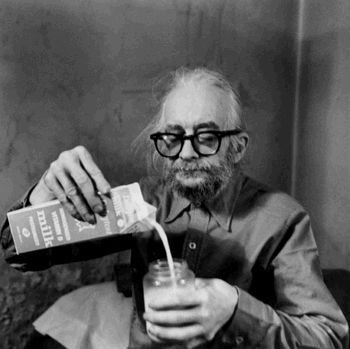
Through the course of examining and re-examining the work of Philip K. Dick, I have been able to discern but a few more things from Do Androids Dream of Electric Sheep?, that I did not already recognize upon my first reading of the text. Possessing a basic knowledge of Dick's tormented existence, I could understand most of allusions and symbolism behind what is possibly his most famous work. However, a deeper comprehension of his childhood, his numerous wives, and spiritual experiences only helped to cement my assertions concerning the novel. For example, Philip K. Dick's Exegesis secured my beliefs that Dick was largely affected by not only apocryphal understandings of Biblical events, but also by Buddhism and Hinduism. These religious tendencies are evidenced by the allusions to the unity and sanctity of life via the empathy box and Mercerism within the novel. Learning of Dick's visions of St. Thomas and Jesus also influenced my interpretation of the text, as it reaffirmed the initial connections I drew between Do Androids Dream of Electric Sheep?, A Course in Miracles, and Disappearance of the Universe. Dick's Exegesis also rejects the normal perceptions of reality, time, and consciousness. Playing off the idea of artifice versus authenticity by creating both android and human characters, Dick reasserts these same concepts. This elemental understanding of the novel coincided with a parallel study of the manipulation of memory and truth, which only enriched my experience with the text. Ultimately, reading and analyzing
Philip K. Dick's work seemed almost intuitive and overwhelming at the
same time. The consequent review of the prose left me in admiration
of the novelist who could take a depreciated genre and elevate it to
something awe-inspiring and truly profound.
Tuesday, April 3, 2012

Sunday, March 4, 2012
The Content Of Consciousness
Contents Page by Stephen Edgar : The Poetry Foundation
In this poem, Stephen Edgar is clearly dealing with the ideas on nature and the evolution of man. The success of this poem, however, does not come from mere "content," which I believe enhances Edgar's theme. Even the structure alludes to a sort of natural hierarchy, which mirrors the masterful imagery within each verse. Edgar almost seems to be listing the range of natural life from prey to predator, from "jungle" to savanna." The vertical assemblage is purposely reminiscent of a table of contents. This reminds the audience to consider the meaning behind the poem's title, as they venture onward through the enthralling language. From the rhythm and rhyme to the saturated tone, Edgar elevates cold, categorical taxonomy to an art. The audience sees the scope of biological existence, the constant and overlapping fight for survival through a florid lens. This dichotomy between the unsentimental reality and the sheer artistry of the poem accentuates Edgar's theme on the importance of creation and consciousness. The poem contains an unspoken conflict between the objective and subjective worlds. Within the scope of the poem, it is not enough to simply exist. Without the tools to perceive, create and comprehend the inherent beauty of nature, life is simply "a fable set down in invisible ink." The human obsession and need for meaning is apparent within the text, and the text itself is an embodiment of this desire. Edgar attempts to convey this urgent appetite for significant "content" through the sacrifices and progress man has made. Man left the light "of the day, into a cave's dark reach" in order to satiate this unnatural inclination to paint on its interior stone walls. The phrase "of his five fingers" also suggests the evolution and progression of man. Edgar alludes to this remarkable attribute through his rhythmic play with five and ten syllable lines. Almost as if hands were reaching out to describe the primitive scenes, the alternate five and ten syllables reminds the audience of the gift of the retractable thumb, especially in contrast with that "two-toed sloth." Humans record history, classify animals, and author poems to fulfill their own emotional longing for purpose. Ultimately, to live without expression, curiosity, and memory is hardly satisfying.
In this poem, Stephen Edgar is clearly dealing with the ideas on nature and the evolution of man. The success of this poem, however, does not come from mere "content," which I believe enhances Edgar's theme. Even the structure alludes to a sort of natural hierarchy, which mirrors the masterful imagery within each verse. Edgar almost seems to be listing the range of natural life from prey to predator, from "jungle" to savanna." The vertical assemblage is purposely reminiscent of a table of contents. This reminds the audience to consider the meaning behind the poem's title, as they venture onward through the enthralling language. From the rhythm and rhyme to the saturated tone, Edgar elevates cold, categorical taxonomy to an art. The audience sees the scope of biological existence, the constant and overlapping fight for survival through a florid lens. This dichotomy between the unsentimental reality and the sheer artistry of the poem accentuates Edgar's theme on the importance of creation and consciousness. The poem contains an unspoken conflict between the objective and subjective worlds. Within the scope of the poem, it is not enough to simply exist. Without the tools to perceive, create and comprehend the inherent beauty of nature, life is simply "a fable set down in invisible ink." The human obsession and need for meaning is apparent within the text, and the text itself is an embodiment of this desire. Edgar attempts to convey this urgent appetite for significant "content" through the sacrifices and progress man has made. Man left the light "of the day, into a cave's dark reach" in order to satiate this unnatural inclination to paint on its interior stone walls. The phrase "of his five fingers" also suggests the evolution and progression of man. Edgar alludes to this remarkable attribute through his rhythmic play with five and ten syllable lines. Almost as if hands were reaching out to describe the primitive scenes, the alternate five and ten syllables reminds the audience of the gift of the retractable thumb, especially in contrast with that "two-toed sloth." Humans record history, classify animals, and author poems to fulfill their own emotional longing for purpose. Ultimately, to live without expression, curiosity, and memory is hardly satisfying.
Tuesday, February 28, 2012
To Boldly Go
Albert Einstein once asserted: “Information is not knowledge.” This relationship with commonly accepted truths and stagnation exemplifies the need for constant, unending inquiry. The minute that we assume that something is correct, we place our trust in others and yield to inactivity. Almost everything that once was, has now been disproven through the constant progression of the human mind. If we accept current knowledge as an absolute, unchanging certainty, then complacency will soon give way to ignorance. The use of memory will almost always lead to mental lethargy. Personal experience can likewise lead to incomplete understandings. Early observers of the Sun, watched as it appeared to move from east to west each day, and assumed that the Sun revolved around the Earth. Others would later prove that the Sun was the center of our Solar System. However, even this information should not be acknowledged as absolute either, or else humans would fall prey to the same naïve mindset as those in the Middle Ages. There was a time when Rome was the central religious and political authority in the West, based on the assumption that there was one Catholic God. At another point in time, Karl Marx was revered as a prophet and the foremost authority in history, economics, and politics. Freud's landmark discoveries were once thought of as undeniable elements in modern psychology. All of these facets of the human experience have been denounced or disproved at one time or another. Knowledge represents a ever-changing, adaptive process of applying the mind to the unsolvable mysteries that abound in the universe. The answers and solutions, the mere information, will never remain constant, or endure for very long. To challenge one's own memory and personal experience is where true progress lies. A process that seems at once counter-productive and counter-intuitive, will only enable the mind to venture into unknown territory and discover true potential and possibility. The thirst for these unobtainable truths, however, will always prompt humans to further examine and analyze the enigmas that surround them.
Monday, February 27, 2012
To the Right
“Many people have observed that truth is stranger than fiction. This has led some intellectuals to conclude that it's stranger than non-fiction as well.” - Brad Holland
Often times the evidence used to substantiate a work of fictional writing is the same as that which is used to substantiate a work of non-fictional writing, though we do not often recognize it. In creating a work of fiction we use the same skills of deduction and observation as we do in creating a work of non-fiction. The best forms of creative writing use the elemental truths that are universally discernible. Good non-fiction writing utilizes the same faculties. Readers should be able to identify with a strong sense of logic or emotion or believability in any form of composition. Generally the difference between these two camps of writing stems from the requirement, or lack thereof, to cite the sources of information and inspiration that catalyze the work. Even for some forms of non-fiction citing sources becomes unnecessary. Reflexive and personal writing, for example, do not face the same level of criticism, with regard to legitimacy, as academic and scholarly writing. If a work is personal or reflexive, the most important audience is obviously the writer, who mostly likely doesn't mistrust his own judgment or memory. However, this is not always the case. Conversely, some creative forms of writing require adequate citations. Creative non-fiction, such as Truman Capote's revolutionary work In Cold Blood, falls into this category. For these types of writing, journals, news organizations, encyclopedias, and reputable sources normally lend compositions some measure of merit. Ultimately, anything that propels an author or poet to set pen to paper, or finger to key, falls under the category as evidence. It seems strange to me that some sources for such work are considered more acceptable than others, when everything that is or could be derives from the same place: the mind. It is up to the audience to connect to a work and give it the popularity and appreciation that owes to a certain air of timelessness.
Sunday, February 26, 2012
The Human's Dilemma
“Anger Against Beasts” - (1971) Wendell Berry
“The hook of adrenalin shoves
into the blood. Man's will,
long schooled to kill or have
its way, would drive the beast
against nature, transcend
the impossible in simple fury.
The blow falls like a dead seed.
It is defeat, for beasts
do not pardon, but heal or die
in the absence of the past.
The blow survives in the man.
His triumph is a wound. Spent,
he must wait the slow
unalterable forgiveness of time.”
A pioneer in environmental awareness and writing, a farmer, and poet, Wendell Berry has been the inspiration for some of the most prolific writers in the 21st Century. Revered and beloved, his work and his example have great meaning to me. The first time I read this poem tears welled in my eyes and I knew that I would always appreciate his work. The beauty of his work, and this poem in particular, comes from the conciseness of the verse, and the unmasked quality of the sentiments expressed. Berry is unafraid to convey the severe, harsh reality of life, and the human's relationship to other living things, amidst all this biological confusion. His line breaks emphasize this constructed brevity, as they lend to an attractive rhythm that smoothly carries his words throughout the poem. Without seeming elementary or trite, Berry also uses subtle repetition and rhyme to reinforce his theme and tone. “Man's will” and the phrase “schooled to kill” obviously rhyme, but are placed in a way to make the meaning of the words superior to the sound of the words. Another was Berry uses rhyme in an unobtrusive way, is through the use of slant rhymes. Words like “seed,” defeat,” and “beasts” follow one another to establish a sort of movement or flow within the text, without overpowering the significance of the words themselves. Berry also uses repetition to accentuate the more important images of the poem. “Man,” “beast,” and “the blow” are used multiple times to pronounce the major players and events in this narrative. Ultimately, the violence used against beast reflexively harms man in the process. Berry underscores the sense of guilt all good men should feel in using aggression against an innocent being.
The Perfect Human
Communal memory and experience are often dictated by those with the power, intelligence, or popularity to establish cultural norms, values, and ideologies. These same people make imperative decisions for the community regarding action and opinion. Ironically, the opposite occurs as well. Such is the case with politicians. Those in the GOP are expected adhere to a certain absurd ideology, because the public expects a certain rhetoric. Conversely, popular politicians and varying prominent figures in society can also determine what is normal and what ideologies and values are important to the culture that surrounds them. Both the use and creation of memory are unethical and yet necessary, to an extent. To use memory is to make assumptions regarding the past, most of which have been swayed by emotion, preference, or the power of others. To create memory is to imbue others with a false sense of self or community. Both are unavoidable and natural within daily life and society. Meville Herskovits recognizes the relationship between these cultural characteristics and a conformed memory of history and experience that sways a collective perception of materiality. According to Herskovits, African culture, as examined through the Western sieve, is morally bankrupt and ideologically backward. However, those same Africans being judged through by the Western mentality, in turn judge Western culture with the same harsh criticisms. Herskovits asserts that all cultural values are gathered and assimilated through “the group into which [we are] born.” Ultimately, absolute values become “intangibles.” The same holds true in the arguments expressed by Elizabeth Loftus. Translated to a more intimate level, Loftus proves that memory is a subjective construct of the world around us. As the environment changes, so to does our perception of the events. This relates to a quote from Seinfeld that has been featured lately within the media, “It's not a lie, if you believe it's true.” Taken out of it's comedic context, the quote honestly conveys what Loftus has been asserting throughout her career. Through various experiments and in-depth research, Loftus has shown that people can be made to remember events that did not occur. This demonstrates the overall nature of memory, especially within the confines of a community. Via the influence of others and a cultural environment, memory can manipulate and be manipulated. This action can neither be ethical nor unethical in and of itself, but rather becomes unethical depending on the circumstances and means by which memory is being manipulated. Often this accumulation of shared memory or understandings, gives meaning and definition to specific societies and geographic entities. The separation and development of shared cultural memory and experience has led to both conflict and unity. Despite the many horrors and complexities of it's existence and operation, cultural memory is synonymous to the human experience.
Sunday, February 12, 2012
A Disheartening Reflection
It's been a while since I have taken an in-class essay exam. To be sure, last semester I took several “essay” exams, however, the questions were released beforehand and the professor encouraged the use of the lecture formatting and material for the essay structure and content. Most of the work required little analysis or original thought. I must admit I was thrown by the questions that I saw. Many of the questions made sweeping generalizations or covered too much of the text to be effective for in-class essay writing. However, instead of simply working with what I was given, my stubbornness gave way to doubt. I found myself second guessing decisions that would have normally required little thought. This indecisiveness ate up most of my time. Now that I am out of the swing of fast-paced writing the strains and confines of such composition seem much more difficult. Practice could have definitely improved my chances of finishing both essays on time. The early hour of the class also seemed to be a hindrance to my abilities. Having stayed up to past 3:00 AM in the morning that day, I was ill equipped to face the daunting task of writing two cogent essays in such a limited time period. The one essay that I did complete was fairly sparse and disorganized. Although a certain quality of imperfection is to be expected in timed writing, I don't know how my essay fared in relation to expectations. The whole experience flew by in a blur of exhaustion and a sense of urgency. In fact, I have no idea how well I did on the exam, because I remember very little of it. I did have time to briefly outline a second essay before time was called. Mostly I think my writing suffered from my crippling insomnia, and a time consuming self-doubt. Extra preparation would have certainly sharpened my timed writing skills. Also, retaining a positive, yet pragmatic mentality can really make the difference between an incomplete essay and a satisfactory product.
Monday, February 6, 2012
Monocultures and Exercises in Objectivity
Shared understandings, especially with respect to culture, can be very deceiving, not to mention very dangerous, as evidenced by "If Hitler Asked You to Electrocute a Stanger, Would You?" "Cultural Relativism and Cultural Values" and "The Challenge of Cultural Relativism." Despite the fact that these three articles are often in conflict with one another, all three admit that cultural diversity exists, and that no one culture can definitively decide what is ethical for all people in every situation. This is an important relevation to keep in mind, notably with those matters that pertain to foreign affairs and this contemporary concept of "globalization." Shared understandings give the impression of paternalism and superiority, particularly with regard to dissenting opinions. For example, most Americans are of the opinion that democracy is the best, most effective form of government, and belief in this ideology generally dictates how the United States' government interacts with other nations. Often, the United States has engaged in warfare and conflict with nations of differing ideologies. However, the US doesn't engage in warfare with every country that doesn't employ the democratic system. Who makes the distinction as to what nation needs to be democratized more than others? Disregarding other political motives than purely the desire to democratize a nation, what made Iraq a more imperative front than North Korea? Both nations had the capacity to do great harm, and the citizens of both nations "needed" democracy as much as the other; in fact, the case can be made that North Korean citizens have been living in a greater magnitude of oppression than those citizens under Sudam Hussein's regime. This inconsistency illuminates how arbitrary or "banal," as Hannah Arendt would say, these culturally relevant decisions truly are. All culturally relevant decisions (some might argue that every decision is relevant to culture) are relative to the time and place in which they occur, as James Rachels would argue. Just because Nazis found it ethical to systematically kill millions of Jews, Gypsies, Homosexuals, and other minorities, within that culture at that point in time, does not make it, in any way or capacity, ethical. In fact, whenever there is a common understanding in a culture, that should be the time to reexamine and disect why exactly a majority of the people of a specific culture believe what they do.
This applies directly to writing as well. It is not enough to assert something without the evidence, and we cannot assume that the audience will possess the same shared understandings. To simply say something within a vacuum is fine, however, if you want to convince anyone of anything, or hold any amount of credibility, you must support your claims through the use of logos, ethos, and even pathos. A writer must also take into account the opposing viewpoint. Without examining what others believe and assert, you may be missing the opportunity to connect to or counterbalance domineering ideologies. Also, the complete refusal to acknowledge that another side or option exists can seem ignorant or stubborn to readers. No matter what circumstance, these ideas should be considered while writing. Whether it be during a timed exam or a master's dissertation, evidence and perspective should always be present within the prose.
This applies directly to writing as well. It is not enough to assert something without the evidence, and we cannot assume that the audience will possess the same shared understandings. To simply say something within a vacuum is fine, however, if you want to convince anyone of anything, or hold any amount of credibility, you must support your claims through the use of logos, ethos, and even pathos. A writer must also take into account the opposing viewpoint. Without examining what others believe and assert, you may be missing the opportunity to connect to or counterbalance domineering ideologies. Also, the complete refusal to acknowledge that another side or option exists can seem ignorant or stubborn to readers. No matter what circumstance, these ideas should be considered while writing. Whether it be during a timed exam or a master's dissertation, evidence and perspective should always be present within the prose.
The Still of The Night
"Rooms" - (2011) Brian Henry
"There are rooms that know you, rooms you know
& can name, rooms that rise & stutter
into view if you stare long enough.
Rooms where nothing happened
but in your head, where the world went on
apart from you, you trying to rise to it.
Rooms with walls of white blocks,
one window, the only sound the bang
bang banging of the headboard
against the wall, your bed still.
The room where the bed fell on you,
the room where the hand going down
was not your own, the groping tongue
the proof. The room you talked your way
out of, four men of monosyllables,
thick arms & necks flushed pink,
closing in, emptying the air between.
The room where you were walked in on,
the room where you were the walker,
both times the last time in that room.
The room with no door, a woman
across the threshold, you crawling to her,
over her to the bathroom to press your cheek
against the white, your name
an indictment among the stalls.
The room the sun never touched,
the sound of cars dropping you to sleep,
your pupils large & hungry for light."
While cruising the electronic byways of poetryfoundation.org, I came across this little gem. It struck me straight away as being indicative of the human experience. It was subtly reminiscent of the illusion of reality, memory, and the falsehood of imaginative processes. I momentarily hesitated to share this poem, due to its violent accuracy with which it portrays a wandering and wanton mind. After some quick research into the author, however, I decided it would be appropriate. Apparently, Brian Henry lives in Richmond, Virginia of all places, and teaches at the University of Richmond no less. He's a translator, professor, poet, and critic whose work has been published internationally. I find the fact that he currently works at a university central to this poem, especially a university in Richmond. Published in 2011, this poem seems to draw inspiration from the contagious environment of student life and the Richmond area. There is a palpable, urban quality to this poem, that would seem to relate to the Richmond area. The cold and salacious sexual allusions, the “walls of white blocks,” with “one window,” the “indictment among the stalls,” “the room the sun never touched,” “the sound of cars,” all seem evocative of a certain industrial and indifferent setting. I frequently find myself writing work that is very similar in style while located in Richmond. There is a unique disconnection and disunity of man and nature within city limits. There is a sort of Kafkaesque ambience in the poem, and also in Richmond. Many of the same themes are brought up in “Rooms” as are in “The Metamorphosis.” Isolation and apathy seem to go hand in hand with the fast-paced, career-oriented lifestyles of cities.
"There are rooms that know you, rooms you know
& can name, rooms that rise & stutter
into view if you stare long enough.
Rooms where nothing happened
but in your head, where the world went on
apart from you, you trying to rise to it.
Rooms with walls of white blocks,
one window, the only sound the bang
bang banging of the headboard
against the wall, your bed still.
The room where the bed fell on you,
the room where the hand going down
was not your own, the groping tongue
the proof. The room you talked your way
out of, four men of monosyllables,
thick arms & necks flushed pink,
closing in, emptying the air between.
The room where you were walked in on,
the room where you were the walker,
both times the last time in that room.
The room with no door, a woman
across the threshold, you crawling to her,
over her to the bathroom to press your cheek
against the white, your name
an indictment among the stalls.
The room the sun never touched,
the sound of cars dropping you to sleep,
your pupils large & hungry for light."
While cruising the electronic byways of poetryfoundation.org, I came across this little gem. It struck me straight away as being indicative of the human experience. It was subtly reminiscent of the illusion of reality, memory, and the falsehood of imaginative processes. I momentarily hesitated to share this poem, due to its violent accuracy with which it portrays a wandering and wanton mind. After some quick research into the author, however, I decided it would be appropriate. Apparently, Brian Henry lives in Richmond, Virginia of all places, and teaches at the University of Richmond no less. He's a translator, professor, poet, and critic whose work has been published internationally. I find the fact that he currently works at a university central to this poem, especially a university in Richmond. Published in 2011, this poem seems to draw inspiration from the contagious environment of student life and the Richmond area. There is a palpable, urban quality to this poem, that would seem to relate to the Richmond area. The cold and salacious sexual allusions, the “walls of white blocks,” with “one window,” the “indictment among the stalls,” “the room the sun never touched,” “the sound of cars,” all seem evocative of a certain industrial and indifferent setting. I frequently find myself writing work that is very similar in style while located in Richmond. There is a unique disconnection and disunity of man and nature within city limits. There is a sort of Kafkaesque ambience in the poem, and also in Richmond. Many of the same themes are brought up in “Rooms” as are in “The Metamorphosis.” Isolation and apathy seem to go hand in hand with the fast-paced, career-oriented lifestyles of cities.
Both Sides Now
Does Rick Deckard benefit or suffer from his commitment to his profession in Do Androids Dream of Electric Sheep? Use evidence to support your argument.
Rick Deckard's career plays an integral part in his life, especially on the particular day that the novel Do Androids Dream of Electric Sheep? takes place. As a bounty hunter, Rick has the opportunity to move up the social ladder and secure some mental stability within the course of the day. His quest for the American dream leads him on a difficult path, and audiences are left wondering whether he would have been better off declining to do the task his boss had assigned him. Rick Deckard's commitment to his career and a lifestyle centered around capital, damaged him physically, but improved him emotionally, which is more significant in the context of the novel.
Physically whole, and brimming with the confidence and ambition of a healthy, normal man, Rick Deckard was ready to take on any task in order to achieve a greater social status. Deckard was so obsessed with this goal that he was willing to chance almost certain death to achieve it. Despite finally accomplishing his set goal, and earning 8,000 credits, Rick Deckard finishes his day in a worse physical state than he had started it. With regard to his body, he cuts his ear, becomes exhausted to the point of malfunction, and suffers a blow to the groin which could potentially ruin all hopes he had for procreating (pages 179, 231, 243). In many ways, Rick Deckard lost his manhood as he was toyed with and controlled by a femme fatale android, and possibly becames sterile by the book's end (pages 202, 231). In addition to the significant damage to his physical frame, he also takes on vast economic losses. Rick Deckard buys a goat on credit, in order to assert his social standing (page 169). Not only does he spend his total earnings of the day on a class symbol, but he also amasses a huge amount of debt (page 170). Before the day ends, the goat is brutally and vengefully killed, which leaves Rick in severe debt with nothing to show for it (page 226). While Rick starts the day with one electric animal, and ends the day with two, they both represent something that is reprehensible to society and adverse to Rick's initial aspirations. A capitalistic or a positivist might look at this situation and say that Rick fell prey to hubris, leaving him worse for the wear by the novel's end. Other aspects of Rick's life, however, seem to improve through these worsening of conditions, which merit careful examination.
Material wealth dominated Rick Deckard's whole mindset, and defined what it meant to be successful in life. If he retained this weltanschauung, undoubtedly scholars would say that Rick turned out to be a failure by the end of the novel. Even after the exhaustion, an identity crisis, and a moral reevaluation of his life he still seems contented as the novel concludes. In fact, a case could be made that he is more contented when he returns home than when he left it the morning earlier. Before he went to work at the beginning of Do Androids Dream of Electric Sheep? he felt imprisoned in a hopeless, loveless marriage (page 94). Rick is also discouraged by every facet in his life, his job, his home, his property, and even himself (pages 9, 13). Even after he discovers that his prized toad is fake, he still finds happiness and satisfaction. When, in the last chapter, his wife “kissed him... his face lit up, almost as much as before—before she had shown him that the toad was electric,” (page 242). This represents an astounding transformation, as Rick Deckard can find happiness in his life despite the emotional trauma and economic ruin that befell him, especially when he was dissatisfied with his life in the midst of former stability. He also gains miraculous insight into the ideology of Mercer, as he endures taxing trials and learns the true meaning of empathy through his journey (pages 174, 231). The fact that he can feel fulfilled in these circumstances leaves him richer by the end of the novel than at the beginning.
While Rick Deckard suffers supreme physical and material loses through the course of the novel, he develops a more mature understanding of himself and the world that allows him to appreciate his own reality. Ultimately, the change from discontent to newfound gratitude outweighs any financial or corporeal loss Rick Deckard sustained.
Sunday, January 29, 2012
Reminiscent Revelations
"In My Craft or Sullen Art" - Dylan Thomas
"In my craft or sullen art
Exercised in the still night
When only the moon rages
And the lovers lie abed
With all their griefs in their arms,
I labour by singing light
Not for ambition or bread
Or the strut and trade of charms
On the ivory stages
But for the common wages
Of their most secret heart.
Not for the proud man apart
From the raging moon I write
On these spindrift pages
Nor for the towering dead
With their nightingales and psalms
But for the lovers, their arms
Round the griefs of the ages,
Who pay no praise or wages
Nor heed my craft or art."
The method and meaning of any work are directly correlative. One does not occur without the other, and the comprehension of one will obviously illuminate the other. In order to understand the techniques an author employs, you first must read the work, a difficult and daunting task, I know. However, I think the best way to discern both the meaning and the method behind a work of literature, or otherwise, is to ask unceasing questions and make unrelenting observations. Many times the same questions that clarify the symbolism and themes of a piece will also help to elucidate the means by which the author created the work. Inquiries such as “why?” and “how?” can always help the audience to apprehend a piece more fully. This level of engagement with a text will vastly improve not only your awareness and knowledge of the piece, but also your connection to it, which will make the experience more intimate, as well as more enjoyable. Once personally invested, it will not be hard to want to interact with the text. Outside research can also enlighten certain aspects of a composition. Knowledge of the author or the era of the work will ultimately enhance the reader's understanding. As the audience begins to realize why the author wrote what (s)he did in the manner that (s)he did, a richer meaning behind the text will subsequently follow.
"In my craft or sullen art
Exercised in the still night
When only the moon rages
And the lovers lie abed
With all their griefs in their arms,
I labour by singing light
Not for ambition or bread
Or the strut and trade of charms
On the ivory stages
But for the common wages
Of their most secret heart.
Not for the proud man apart
From the raging moon I write
On these spindrift pages
Nor for the towering dead
With their nightingales and psalms
But for the lovers, their arms
Round the griefs of the ages,
Who pay no praise or wages
Nor heed my craft or art."
The method and meaning of any work are directly correlative. One does not occur without the other, and the comprehension of one will obviously illuminate the other. In order to understand the techniques an author employs, you first must read the work, a difficult and daunting task, I know. However, I think the best way to discern both the meaning and the method behind a work of literature, or otherwise, is to ask unceasing questions and make unrelenting observations. Many times the same questions that clarify the symbolism and themes of a piece will also help to elucidate the means by which the author created the work. Inquiries such as “why?” and “how?” can always help the audience to apprehend a piece more fully. This level of engagement with a text will vastly improve not only your awareness and knowledge of the piece, but also your connection to it, which will make the experience more intimate, as well as more enjoyable. Once personally invested, it will not be hard to want to interact with the text. Outside research can also enlighten certain aspects of a composition. Knowledge of the author or the era of the work will ultimately enhance the reader's understanding. As the audience begins to realize why the author wrote what (s)he did in the manner that (s)he did, a richer meaning behind the text will subsequently follow.
The All American
"Homage to Phillip K. Dick" - Norman Dubie
"The illegal ditch riders of the previous night
Will deliver ice today.
The barbers up in the trees are Chinese.
They climb with bright cleats, bearing machetes—
It’s a season
Of low self-esteem for date palms on the street.
My visitor was at the door yesterday.
In a blue sere of a sucker suit.
An I Like Ike button
On the lapel. Holding a cup of sawdust.
He breathed through his eyes, crusted
With pollen.
I was not confused. It was God
Come to straighten my thoughts.
Whole celestial vacuums
In the trunk of his pink Studebaker.
We would smoke and cough.
I sat very still, almost at peace with myself.
He had shot a deer in the mountains. He thought
Last year’s winterkill was worse than usual.
I told him I didn’t know about guns.
Something forming on his forehead—a gloriole
Of splattered sun over snow.
We drank our lemonade in silence.
He asked if he could go. He joked
About his wife’s tuna casserole. As a gift
I signed for him my last paperback.
He left the book of matches. I’ll not enroll
In the correspondence course it offers
For commercial artists. What a relief
That the barbers in the trees are Chinese.
Green fronds are dropping in twos and threes
Around the bungalow, lessons
In the etiquette of diseased parrots. Bill Cody
Said it first, “If there is no God, then I am
His prophet.” Stop it. Please stop it."
Amidst the extensive research and discussion, the only thing I found out for sure about Philip K. Dick was that a myriad of people were sure quick to label the man as insane. For me, however, Philip K. Dick does not conjure up an image of illicit drug use and vivid hallucination, but rather represents the quintessential American. I see a man who suffered immensely in his lifetime, a man who endured great hardship, just like his country. Philip K. Dick witnessed the pain of three major wars, felt the commingling of fear and fascination as the atom bomb fell, and sensed the urgency of civil rights. Dick's life is synonymous to American life, and not just through the events that all Americans share through a strained and collective memory, but through the more personal encounters that Philip K. Dick endured as well. Philip K. Dick's only sibling and twin sister died six weeks after their birth where both of their names were inscribed on the same tombstone; a morbid reminder of the fate that awaited the one who survived. At the age of five his parents had divorced; an event that would set an example for his future love life, as he would marry and divorce five wives throughout his lifetime. As a writer, Dick would be incredibly prolific, but only marginally successful. Philip K. Dick would be diagnosed both as a schizophrenic and as a sane man, depending on the psychiatrist. Eventually Philip K. Dick would die at the young age of 53, not from a stroke, as many believe, but rather the arbitrary decision to turn off his life support system after a series of strokes. All of these events that occurred in his life helped to characterize him as a person, but not necessarily an atypical person. American society and history is wrought with mental illness and social woes. Dick's parents certainly were not the first to divorce each other. Philip's sister Jane, was not the first of a pair of twins to die, while the other survived. No one event in Philip's life was unusual or uncharacteristic of American life. In fact, one of the first purely American religious sects, Mormonism, came about as a result of hallucinations that were, in some respect, similar to those Philip K. Dick experienced. Ultimately, America was founded on the strange and the weird, the Kafkaesque and the obscene. From the Puritans to the Boston Tea Party to The Three-Fifths Compromise to the Civil War, Philip K. Dick is certainly no more unusual than the United States of America, or the rest of the world for that matter. Classic Americana consists of the moon landing, and the Twilight Zone, Coney Island, and the 49ers. So why are people so quick to judge and undermine the genius of this man? Like other American attributes, Philip K. Dick also showed a great talent for imagination and ingenuity. In many ways, Philip K. Dick was a prophet and a doctor of the modern world. He envisioned where society was headed, and identified contemporary problems that would need to be addressed. Through his writing he confronted the issues that faced America and the ideologies of the modern world. He asked confounding questions, and sometimes the illusive answers would wear his mind to the boundaries of sanity. Perhaps, people cannot come to terms with his inescapable inquiries or his unparalleled intellect, perhaps, his familiar lifestyle seems disquieting to those who seek the semblance of normalcy, or maybe they forget what it means to be American; which is a little surreal, a little odd, a little dysfunctional, and certainly imaginative.
"The illegal ditch riders of the previous night
Will deliver ice today.
The barbers up in the trees are Chinese.
They climb with bright cleats, bearing machetes—
It’s a season
Of low self-esteem for date palms on the street.
My visitor was at the door yesterday.
In a blue sere of a sucker suit.
An I Like Ike button
On the lapel. Holding a cup of sawdust.
He breathed through his eyes, crusted
With pollen.
I was not confused. It was God
Come to straighten my thoughts.
Whole celestial vacuums
In the trunk of his pink Studebaker.
We would smoke and cough.
I sat very still, almost at peace with myself.
He had shot a deer in the mountains. He thought
Last year’s winterkill was worse than usual.
I told him I didn’t know about guns.
Something forming on his forehead—a gloriole
Of splattered sun over snow.
We drank our lemonade in silence.
He asked if he could go. He joked
About his wife’s tuna casserole. As a gift
I signed for him my last paperback.
He left the book of matches. I’ll not enroll
In the correspondence course it offers
For commercial artists. What a relief
That the barbers in the trees are Chinese.
Green fronds are dropping in twos and threes
Around the bungalow, lessons
In the etiquette of diseased parrots. Bill Cody
Said it first, “If there is no God, then I am
His prophet.” Stop it. Please stop it."
Amidst the extensive research and discussion, the only thing I found out for sure about Philip K. Dick was that a myriad of people were sure quick to label the man as insane. For me, however, Philip K. Dick does not conjure up an image of illicit drug use and vivid hallucination, but rather represents the quintessential American. I see a man who suffered immensely in his lifetime, a man who endured great hardship, just like his country. Philip K. Dick witnessed the pain of three major wars, felt the commingling of fear and fascination as the atom bomb fell, and sensed the urgency of civil rights. Dick's life is synonymous to American life, and not just through the events that all Americans share through a strained and collective memory, but through the more personal encounters that Philip K. Dick endured as well. Philip K. Dick's only sibling and twin sister died six weeks after their birth where both of their names were inscribed on the same tombstone; a morbid reminder of the fate that awaited the one who survived. At the age of five his parents had divorced; an event that would set an example for his future love life, as he would marry and divorce five wives throughout his lifetime. As a writer, Dick would be incredibly prolific, but only marginally successful. Philip K. Dick would be diagnosed both as a schizophrenic and as a sane man, depending on the psychiatrist. Eventually Philip K. Dick would die at the young age of 53, not from a stroke, as many believe, but rather the arbitrary decision to turn off his life support system after a series of strokes. All of these events that occurred in his life helped to characterize him as a person, but not necessarily an atypical person. American society and history is wrought with mental illness and social woes. Dick's parents certainly were not the first to divorce each other. Philip's sister Jane, was not the first of a pair of twins to die, while the other survived. No one event in Philip's life was unusual or uncharacteristic of American life. In fact, one of the first purely American religious sects, Mormonism, came about as a result of hallucinations that were, in some respect, similar to those Philip K. Dick experienced. Ultimately, America was founded on the strange and the weird, the Kafkaesque and the obscene. From the Puritans to the Boston Tea Party to The Three-Fifths Compromise to the Civil War, Philip K. Dick is certainly no more unusual than the United States of America, or the rest of the world for that matter. Classic Americana consists of the moon landing, and the Twilight Zone, Coney Island, and the 49ers. So why are people so quick to judge and undermine the genius of this man? Like other American attributes, Philip K. Dick also showed a great talent for imagination and ingenuity. In many ways, Philip K. Dick was a prophet and a doctor of the modern world. He envisioned where society was headed, and identified contemporary problems that would need to be addressed. Through his writing he confronted the issues that faced America and the ideologies of the modern world. He asked confounding questions, and sometimes the illusive answers would wear his mind to the boundaries of sanity. Perhaps, people cannot come to terms with his inescapable inquiries or his unparalleled intellect, perhaps, his familiar lifestyle seems disquieting to those who seek the semblance of normalcy, or maybe they forget what it means to be American; which is a little surreal, a little odd, a little dysfunctional, and certainly imaginative.
Systematic Sampling
Very like a Whale by Brook Emery : The Poetry Foundation
Many of the dualistic tensions present in Dick's work are present here. This brings to light how very human these tensions are. Not only does Philip K. Dick struggle with constant, unending debates on the fate and nature of humanity, but so too does the rest of the world. Brook Emery is but one more example on the infinite list of humans who were dissatisfied and disconcerted by their own discoveries, observations, and inquiries. Emery brilliantly plays off the ideas of the centuries. He merges all the conflicting and disjointed ideologies of the past two centuries into a balanced portrayal of existence. The speaker of the poem encapsulates the human experience. The verses are wrought with the doubt and uncertainty of perception. Words like “seem,” “ambiguously,” “misconceive,” “unlikelihood,” “belief,” “imagined,” and “illusions,” set this tone of obscurity and confusion. Reality becomes fluid like the speaker's perception, within the context of the poem. This contrasts starkly with the theories and themes of Darwin and Dawkins, as Emery incorporates the resoluteness of science into the mix of human emotionality. The “peptides/ spelling out the phrase/ very like a whale” allude to a complex theory and practice invented and implemented by Richard Dawkins in order to prove and illuminate the nature of evolution in biological mechanisms, also known as Dawkin's weasel. The fact that Richard Dawkins chose to use Shakespeare in his experiments is mirrored throughout Emery's poem. The “clouds,” “camels,” “weasels,” and “whale[s],” of Hamlet's sky are all present within the text, and enrich its meaning. The idea that Hamlet was a character who could be both sane and insane within the context of the plot, and the fact that Richard Dawkins chose to use Hamlet to prove a wildly complex series of patterns, adds to this tone of surrealism and delusion. Emery uses these scientific discoveries to play off the notion that his words, the events that surround him, and his life have been naturally selected in a reality that is both wondrously illusive and positively concrete at the same time.
Sunday, January 22, 2012
Oh, the Semblance of Sanity
Dictionary.com defines “reality” as “the state or quality of being real.” The site then goes on to define “real” as “something that actually exists.” In truth, there aren't many things on this earth that are objectively, positively, materialistically, singularly, real or in a state of verifiable existence. Ultimately, what people generally perceive as reality has been, to some extent, demolished. A state of existence, any state of existence, remains purely subjective and relative. One person's reality can completely differ from another person's reality. The reality of a young Somalian boy does not in any way resemble that of a middle-aged white man from Boston. So we must accept that reality takes many forms at the same time, or that reality does not exist in the previously established context. Einstein proved, or appeared to prove, all this through his research and discovery of relativity. Soon things that were always considered materialistic and verifiable were dismissed as toys of perception, such as space and time. This now applies to the entirety of the universe. By disproving, or putting into question, this one aspect of so-called reality, we must now learn to deny or question anything that was implicitly acknowledged as reality. If existence is based on the principle of experience and all that can be measured by the senses, then reality cannot exist. How do we know we are experiencing what we are experiencing? Descartes' age-old aphorism “I think, therefore I am” holds little to no validity. According to the principles of science, observation, and rational thinking, descended from the Enlightenment, it should be “I think, therefore I think.” Despite it's Yogi Berra-like appearance, I still believe this sentiment holds value. The only proof in thinking is that you thought you had a thought at one point in time that may or may not have existed in reality. Measuring the present enters the realm of the absurd and the impossible. All we can do is attempt to measure the past, which is a figment of perception, and lacks verification. This is why humans have dedicated their lives to history and have documented their lives with the greatest care, because of an existential need to prove that they exist and have existed in reality. However, whatever anyone has documented or written or done has been in the past, which is not in the realm of reality because it is not existing at that moment in time. As soon as a thought or feeling or reaction enters your brain the experience has already passed. Another outlook to this paradox of the human condition is expressed by Buddha, “All that we are is the result of what we have thought. The mind is everything. What we think, we become.” While similar to Descartes' inference, I find Buddha's quote much more realistic in terms of the relationship he cites between the nature of existence, reality, and perception. Buddha places emphasis on the past tense; “[what] we are is... what we have thought.” The present condition and perception of all things is a result of what we have already thought, and what has been placed in the past. Since the past does not exist as something that can be experienced or measured in terms of the present, and the present is dependent on the past, there is neither past nor present. Just as Herskovits wrote regarding cultural relativism, one person may swear on his life that he was possessed by God, whereas another person would attribute the experience to hallucinatory pathology. Both perceptions are mute because both the experience and the diagnosis occurred in the past, and are therefore beyond the field of objectivity, but rather subjectivity. As I said before reality is dependent on the realm of measurable experiences and data, which are all fluid, intangible, and subject to manipulation through the means of personal perception. All of humanity is an abstraction, created on the assumption that what I may or may not have felt or experienced a few milliseconds ago actually occurred. This is an absurd and naïve assumption that simply cannot be proved, because as soon as you measure the synapses in the brain firing, which alludes to a possible reaction to something in the environment, the data has elapsed into the intangible former world of experience. The events that comprise our daily lives, the assumptions, the complacency is a ruse to make existence conceivable to the human mind, and is brought about by an inherent need for placement, meaning, and emotional security in a confusing and complex state. Furthermore, I completely realize the insanity and illogic present in all of these statements, because they were all conceived in the past and all constructed on past assumptions and evidence. In many ways, however, this just reaffirms my argument on the absurdity of trying to define reality, because nothing actually exists in a measurable, present form. Perhaps this is just my way of being contrarian for the sheer fun of it. However, whether verifiable or not, I still maintain that consciousness, experience, existence and reality could be illusory. So maybe it would be more appropriate to consider the second definition of “reality” that www.dictionary.com lists after all this confusion; “resemblance to what is real.”
Oral Traditions and The Colloquial Man
Oral communication and presentation constitute an immensely large portion of human existence, as well as academic endeavor. However, I feel scholars, and people in general, spend little time analyzing the way humans speak, or appreciating the art of storytelling, which, after all, catalyzed the formation and practice of the written word. Harry Smith, similar to Professor Higgins, could tell what county of the United States a man or woman originated after hearing them sing but a few bars of music. The oral tradition is so vital to our way of life, yet so depreciated. The progression and proliferation of technology has helped to alienate people from actually speaking on a day to day basis. So, I would like to spend some time honoring a person whom I feel embodies this slowly dying art form: Louis CK. In my opinion, Louis CK represents the perfect communion of the spoken and written language. I'm sure many would disagree with this statement, considering the high volume of profanity Louis CK uses in his routines, however, he is one of the few comedians who really considers the role of linguistics in everyday life, and the impact our lack of verbal skills has on the quality of society as a whole.
Louis CK even expands on the definitions and placement of specific diction within our culture. By writing out vulgar language and expanding upon the connotations of certain words, he attempts to understand and define these words with rationality, as opposed to placing common vocabulary among the taboo. In addition, Louis frequently says these words during his performances and in public, thus confronting the idea that a word in and of itself can be abusive, and removing these words from a context of fear and obscenity. I believe Louis CK would be a strong advocate of Cervantes' words, “The pen is the tongue of the mind." The idea that we all must own up to the words we use, hone our narrative skills, and portray an image with the honesty of a newly conceived thought, would certainly resonate with his bizarre sense of integrity.
Considering Louis has been in stand-up since he was nineteen, avid listeners can see his progression as an artist. More importantly his body of work materializes Joan Didion's thoughts on writing; she once wrote,“I write entirely to find out what I’m thinking, what I’m looking at, what I see and what it means. What I want and what I fear.” Louis hasn't always possessed this sense of aestheticism and sincerity. As a younger, less enlightened man, he felt that he could get by with a hollow Vaudeville-style act. As the years went by, he got married and had children, faced economic difficulties, and the same domestic troubles that nearly every family faces. He could no longer relate the product he was selling, the product being himself. He felt that the man on stage did not reflect the man in the mirror. So he changed his style and content to match how he felt. This emotional element makes his work viable. By using a frame of reference, recognizable to every dysfunctional family on the face of the earth, he was not only able to create a satisfactory profession on a personal level, but connect with the audience in a profoundly cathartic way. If the laughing in the background were to be cut from the audio of his work, and another man were to read his material dry, the effect would be tragic. Fortunately, Louis doesn't intend to make people cry or feel sympathetic toward him, but rather, allows the audience to relate to and laugh with him over the traumatic experiences in their own life. The audience doesn't simply laugh at a bunch of inane babble, but rather can identify with the experiences and observations Louis has on a daily basis. Brutally honest, brave, unashamed, candid, and at the same time therapeutic, Louis provides a service unmatched in the literary and performing world.
Unafraid and unhindered by the prospect of judgment and persecution, Louis uses comedy and the art of oral communication to invite opportunities for analysis and objective, critical thinking. Whether it's an existential examination of modern society, an exposé on the perversity of mankind, or just a wildly embarrassing confession, Louis, in some cases, uses the stage as a soapbox or pulpit. This enhances the thematic quality of his work above mere entertainment. Whether deliberately didactic, Louis' work always manages to inspire empathy, tolerance, inquiry, and greater comprehension of this complex world, along with a few liberating laughs. Louis CK, quite frankly, epitomizes the words of T.S. Eliot “Only those who risk going too far can possibly find out how far one can go.”
Louis CK even expands on the definitions and placement of specific diction within our culture. By writing out vulgar language and expanding upon the connotations of certain words, he attempts to understand and define these words with rationality, as opposed to placing common vocabulary among the taboo. In addition, Louis frequently says these words during his performances and in public, thus confronting the idea that a word in and of itself can be abusive, and removing these words from a context of fear and obscenity. I believe Louis CK would be a strong advocate of Cervantes' words, “The pen is the tongue of the mind." The idea that we all must own up to the words we use, hone our narrative skills, and portray an image with the honesty of a newly conceived thought, would certainly resonate with his bizarre sense of integrity.
Considering Louis has been in stand-up since he was nineteen, avid listeners can see his progression as an artist. More importantly his body of work materializes Joan Didion's thoughts on writing; she once wrote,“I write entirely to find out what I’m thinking, what I’m looking at, what I see and what it means. What I want and what I fear.” Louis hasn't always possessed this sense of aestheticism and sincerity. As a younger, less enlightened man, he felt that he could get by with a hollow Vaudeville-style act. As the years went by, he got married and had children, faced economic difficulties, and the same domestic troubles that nearly every family faces. He could no longer relate the product he was selling, the product being himself. He felt that the man on stage did not reflect the man in the mirror. So he changed his style and content to match how he felt. This emotional element makes his work viable. By using a frame of reference, recognizable to every dysfunctional family on the face of the earth, he was not only able to create a satisfactory profession on a personal level, but connect with the audience in a profoundly cathartic way. If the laughing in the background were to be cut from the audio of his work, and another man were to read his material dry, the effect would be tragic. Fortunately, Louis doesn't intend to make people cry or feel sympathetic toward him, but rather, allows the audience to relate to and laugh with him over the traumatic experiences in their own life. The audience doesn't simply laugh at a bunch of inane babble, but rather can identify with the experiences and observations Louis has on a daily basis. Brutally honest, brave, unashamed, candid, and at the same time therapeutic, Louis provides a service unmatched in the literary and performing world.
versus
Unafraid and unhindered by the prospect of judgment and persecution, Louis uses comedy and the art of oral communication to invite opportunities for analysis and objective, critical thinking. Whether it's an existential examination of modern society, an exposé on the perversity of mankind, or just a wildly embarrassing confession, Louis, in some cases, uses the stage as a soapbox or pulpit. This enhances the thematic quality of his work above mere entertainment. Whether deliberately didactic, Louis' work always manages to inspire empathy, tolerance, inquiry, and greater comprehension of this complex world, along with a few liberating laughs. Louis CK, quite frankly, epitomizes the words of T.S. Eliot “Only those who risk going too far can possibly find out how far one can go.”
Friday, January 20, 2012
Mr. Renard Sends His Warm Regards
Everything. Simply everything. Everything comes to mind when I read Philip's work. And I feel like I can call him Philip too. His writing makes him so vulnerable and transparent, so familiar and, yet, so fallible, he makes intimate friends of us all. We know his follies, his lack of self-esteem, his immense intelligence, his heartbreaking hardships. When an author can make me break into tears on the twenty-first page of a two hundred and forty-four page novel, I know not only that this man has skill as a writer, but that the emotions of this novel come from a genuine and sincere place, Philip K. Dick to be exact. More than the brutal honesty and inquiry that makes any novel successful, he managed to encapsulate the entirety of existence, and even non-existence, into only a couple hundred pages. What rare and afflicting gift possessed Philip to allow him to complete such a task? The same thought flows through my head when I read Ulysses or Waiting for Godot? And I believe that, one day, Philip K. Dick will be held in the same regard as Joyce and Beckett. In Do Androids Dream of Electric Sheep?, I, too, see The Odyssey. The long, exhaustive journey played out in full by Rick Deckard. The Sirens leading the protagonist astray. The imagery of forgotten quests and conquests, a horse and a fake sheep. The horse reminiscent of the Trojan Horse and the sheep evocative of that sheep's hide Odysseus wore to escape from certain death. Rick Deckard easily embodies Odysseus, as he is an imperfect character. He fought a battle for survival in his past, but nothing prepared him for the war going home. All of his values and ideals were challenged, he accomplished some dubious tasks, and he is certainly imperfect. The audience is unsure whether he likes Rick Deckard by the novel's end, the same with Odysseus. He cheated on his waiting wife, and his age is apparent by the end of the day. Perhaps, even, infertile due to the groin injury he obtained, which is certainly a symbol of age. By the last chapters of Do Androids Dream of Electric Sheep?, Iran exemplifies the ever patient and maternal Penelope. While these parallels make a great case for certain elements in the story, I see much, much more. These symbols overlap one another to create a grand and all-encompassing vision of simply everything. Wilbur Mercer, who, in the context of The Odyssey, could be related to Calypso; a guiding force that leads Rick Deckard home, could also be interpreted as any number of historical figures, namely Jesus Christ and Buddha. Mercer most definitely shows signs of being a Christ figure. The idea of a man who can perform miracles at a very young age and then suffers persecution, also seems like Jesus. The imagery of making the grueling hike up a hillside to rejuvenate mankind and all life, while others torture him, absolutely sounds like Christ to me. The idea of rebirth and resurrection should always remind audiences of this famous man. The long period in which Mercer stays at the bottom of the hill, tormented by demonic visions of death, should remind all those who are even vaguely familiar with the New Testament of the Garden of Gethsemane. Also donkeys, sheep, and crows which appear in the novel several times are representative of three significant phases in Jesus' life. But these features don't only apply to Jesus Christ. The fact that Mercer was an orphan (see page 23, a small, but true detail) resembles the life history of Muhammad, another vitally important religious leader. The fact that Muhammad would walk the face of Mount Hira for religious meditation, also resembles Mercer's journey. It is said, according to Islamic scripture that Muhammad, after being visited by an angel, thought about committing suicide and thought that no one would believe him. This is similar to how Rick Deckard feels after experiencing life in Mercer's shoes. The affinity for animals, belief in rebirth, empathy, and unity of Mercerism mirrors many of the beliefs of Buddhists and Hindus. Hindus hold animals in high esteem, are often vegetarian, and believe in reincarnation. The same goes for Buddhists. Buddha emphasized, however, the importance of empathy, unity with fellow living things, and suffering, which are all apparent throughout the course of the novel. The Four Noble Truths can be found throughout Rick Deckard and John Isidore's ventures as both suffer tremendously in their own ways, and learn empathy and unity through common ideas of empathy and rebirth. The idea of a false reality is also present within Buddhism. The most emotional moment of Rick Deckard's venture comes when he finds a frog, a species supposed to be extinct. After learning the frog is simply an android, we can still derive great meaning from it's existence in the plot line. One: Rick Deckard suffers a supreme emotional loss because of this discovery, and, two: reality is an illusion, something that Buddha highly endorsed. Buddha felt that the only real and permanent form of existence came with Nirvana and the idea of evolved emotional capacities that could perfectly empathize and love others in the face of this illusion of reality and demoralizing desires and selfishness. However, one fact about Indian life Buddha did not advocate was the Pariah State, in which classes were strictly divided into those who were worthy of living and those who were not. This dichotomy is present in the form of “humans” versus “androids” in Do Androids Dream of Electric Sheep? As Rick Deckard ventures out of his comfort zone, and embarks on this mission, his ideas of the value of life and what constitutes life vastly differ when he returns home the next day. This transformation is similar to, yes, Odysseus, but also Gautama Buddha's journey from luxury and ignorance to enlightenment. By the end of the day, Rick isn't entirely sure that he has done the right thing, and this is important for the reader to understand, especially that he feels guilt on behalf of and empathy for these androids, the supposed pariahs of Earth. Philip K. Dick also looks to all these religions, and many more, when picking out the specific animals present in the story, for the most saturated amount of meaning and symbolism in the context, of which I could go on forever. Ultimately each religious allusion points to the idea of the martyr, love, and a strong sense of spirituality, in this sense, Earth's society is divided in yet another way, those who believe in religion and those who identify with science and rationality. This demonstrates a tumultuous period in human history, a period that is still going on today, the ideological war between atheists and religious thinkers. Philip is clearly adroit when he brings up this topic. He recognizes the fact that many of the people who claim to advocate love and empathy perpetrate the most violence, such as the case with Rick Deckard. However, Philip also recognizes the devastation many atheist caused in being so disrespectful with regard to human faith and hope for the future, such is the case with John Isidore versus the Batys and Pris Stratton. Philip accentuates the imperfection on both sides, which really is the basis for all humanity, a poignant theme to keep in mind.
In conclusion, I thought I would leave you with some words by Walt Whitman, which I found appropriate. It is a segment from "I Sing the Body Electric" from Leaves of Grass.
"A man’s Body at auction;
I help the auctioneer—the sloven does not half know his business.
Gentlemen, look on this wonder!
Whatever the bids of the bidders, they cannot be high enough for
it;
For it the globe lay preparing quintillions of years, without one
animal or plant;
For it the revolving cycles truly and steadily roll’d.
In this head the all-baffling brain;
In it and below it, the makings of heroes."
In conclusion, I thought I would leave you with some words by Walt Whitman, which I found appropriate. It is a segment from "I Sing the Body Electric" from Leaves of Grass.
"A man’s Body at auction;
I help the auctioneer—the sloven does not half know his business.
Gentlemen, look on this wonder!
Whatever the bids of the bidders, they cannot be high enough for
it;
For it the globe lay preparing quintillions of years, without one
animal or plant;
For it the revolving cycles truly and steadily roll’d.
In this head the all-baffling brain;
In it and below it, the makings of heroes."
Subscribe to:
Posts (Atom)